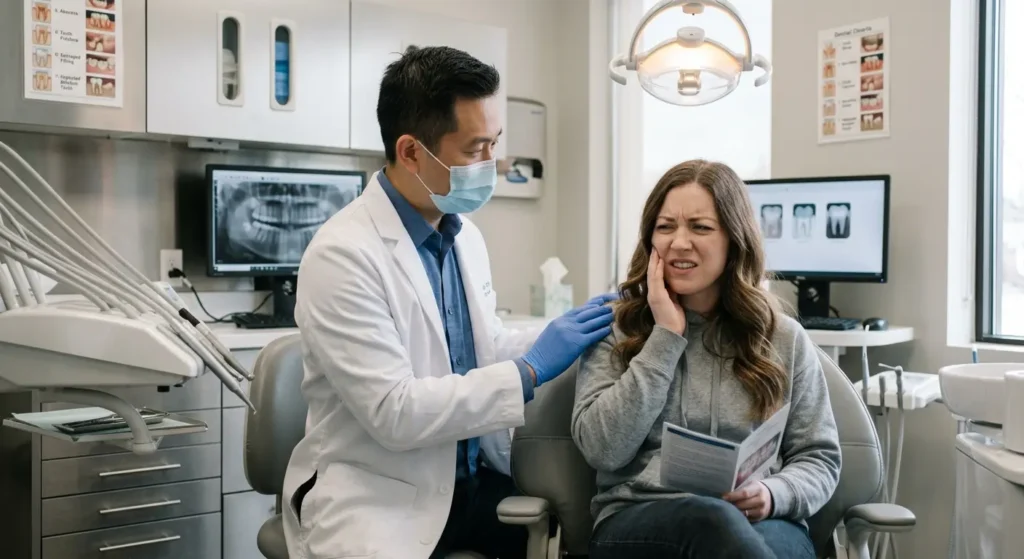
Tooth pain shows up in a lot of different ways — a dull ache after eating, a sharp jolt when you bite down, a throb that keeps you up at night. It’s rarely random. Toothache almost always has a specific cause, and figuring out which one applies to you is what determines whether you need a filling, a course of gum treatment, or something more urgent.
This guide walks through the seven most common reasons teeth hurt, how to tell them apart, and what to actually do next — whether that’s home care while you wait for an appointment or getting seen the same day.
What Causes Toothache?
Most toothache comes from one of a handful of causes: tooth decay, a dental infection or abscess, gum disease, tooth sensitivity, a cracked or damaged tooth, wisdom tooth problems, or issues like a worn filling or teeth grinding. The pain’s location, timing, and triggers give useful clues, but a dentist needs an exam — and sometimes an X-ray — to confirm the actual cause.
1. Tooth Decay and Cavities
Decay develops when acid from bacteria in plaque wears through enamel and into the softer dentin underneath. Early on, a cavity might cause no pain at all. As it deepens, it tends to produce sensitivity to hot, cold, or sweet foods, and eventually a dull ache that can become constant.
Left untreated, decay can progress toward the pulp — the nerve centre of the tooth — and cause more severe, spontaneous pain. Treatment depends on how far the decay has gone: a straightforward filling is often enough if it’s caught early, while decay that has reached the pulp may need root canal treatment to save the tooth. Only an exam can tell you which stage you’re at.
2. Tooth Infection or Dental Abscess
A dental abscess is a pocket of infection, usually linked to untreated decay, a cracked tooth, or advanced gum disease. It tends to cause intense, throbbing pain that can spread to the ear, jaw, or neck, along with swelling, a bad taste in the mouth, or drainage. Some people also develop a fever or a general feeling of being unwell.
An abscess doesn’t resolve on its own and needs professional treatment — draining the infection, treating the tooth, and sometimes antibiotics prescribed by a dentist. If swelling spreads to your face or neck, or you have trouble breathing or swallowing, that’s a sign the infection may be spreading and needs urgent care, not a routine appointment.
3. Gum Disease or Gum Infection
Gum disease starts as gingivitis — inflamed, sometimes bleeding gums caused by plaque buildup along the gumline. Left untreated, it can progress to periodontitis, a more advanced stage that damages the tissue and bone supporting your teeth.
Signs worth noting include gums that bleed when you brush or floss, redness or swelling, persistent bad breath, and, in more advanced cases, teeth that feel loose. Gum-related discomfort is often less sharp than decay-related pain but can still be a sign that something needs attention before it progresses further.
4. Tooth Sensitivity
Sensitivity happens when the protective layers over dentin — enamel on the crown, or gum tissue at the root — wear away or recede, exposing microscopic channels that lead straight to the nerve. It typically shows up as a short, sharp reaction to cold drinks, hot beverages, or sweet foods.
The key difference from other causes of toothache is duration: sensitivity usually fades within seconds of removing the trigger. Pain that lingers well after eating or drinking, or that happens without any trigger at all, points toward something beyond ordinary sensitivity and is worth having checked.
5. Cracked, Broken, or Damaged Tooth
A crack, even one too fine to see, can cause a distinctive pattern: sharp pain when you bite down, followed by a quick release of pain when you let go — sometimes called “rebound pain.” Cracks are often triggered by chewing something hard, grinding your teeth, an old injury, or simply wear over the years.
Because a crack can be hard to see on an X-ray and the pain often doesn’t point to one obvious tooth, cracked teeth are notoriously tricky to diagnose without a dental exam. Treatment varies widely depending on how deep the crack goes and whether it’s reached the pulp — from a simple bonding or crown to root canal treatment or, in severe cases, extraction. Not every cracked tooth needs the same fix, which is exactly why a professional look matters here.
6. Wisdom Tooth Problems
Wisdom teeth that are impacted — stuck under the gum or growing at an angle — or only partially erupted can cause a dull ache toward the back of the jaw, swelling, and sometimes a bad taste if food or bacteria get trapped around the tooth. Partial eruption in particular leaves a flap of gum that’s easy for food to collect under, which can lead to recurring irritation or infection.
This kind of pain is often mistaken for a molar problem since it can radiate along the jaw. If you’re dealing with aching, swelling, or stiffness toward the back of your mouth, it’s worth reading more about wisdom tooth symptoms and when they need dental attention — not all wisdom teeth need removal, but the ones causing recurring pain usually do need an assessment.
7. Other Possible Causes of Tooth Pain
A handful of less common — but still frequent — causes round out the list:
- Worn or loose fillings: An old filling that’s cracked or come loose can let bacteria and temperature reach the tooth underneath.
- Teeth grinding or clenching (bruxism): Often happens during sleep and can cause generalised soreness, jaw fatigue, and worn-down enamel over time.
- Dental trauma: A knock or injury can cause pain even without a visible crack or chip.
- Sinus-related pain: Sinus pressure can sometimes be felt as an ache across the upper back teeth, especially during a cold or allergy flare.
- Referred pain: Pain from one tooth or area can sometimes be felt in a nearby tooth, which is part of why self-diagnosis is unreliable.
Tooth pain can’t always be pinned down from symptoms alone, particularly when a few of these overlap. That’s the main reason a clinical exam exists — it’s not just about confirming what you already suspect.
Toothache vs Tooth Sensitivity: What’s the Difference?
These two get confused often enough that a side-by-side helps:
| Symptom | Possible indication | What to do |
|---|---|---|
| Brief, sharp reaction to cold or hot that fades in seconds | Ordinary dentin sensitivity | Try a sensitivity toothpaste; monitor for change |
| Sharp pain on biting, releases when pressure stops | Possible cracked tooth | Book a dental exam |
| Dull, constant ache, worse over days | Possible decay or infection | See a dentist soon, don’t wait it out |
| Throbbing pain with swelling or fever | Possible abscess | Seek urgent dental care |
| Bleeding, tender or swollen gums | Possible gum disease | Schedule a dental and gum evaluation |
When Is Toothache a Dental Emergency?
Most toothache can wait for a scheduled appointment. A smaller set of warning signs means you should seek care right away:
- Noticeable swelling of the face, jaw, or neck
- Fever alongside tooth or gum pain
- Difficulty swallowing
- Difficulty breathing
- Swelling that appears to be spreading rather than staying localised
- Severe pain that isn’t controlled by over-the-counter painkillers
- A knocked-out, badly broken, or significantly displaced tooth after an injury
Difficulty breathing or swallowing, in particular, means going to an emergency department rather than waiting for a dental appointment — it can indicate that an infection is spreading beyond the tooth. Everything else on this list still needs prompt attention, just not necessarily a 999-style emergency.
What Should You Do When You Have a Toothache?
While you’re arranging to see a dentist, a few sensible steps can make the wait more comfortable:
- Keep brushing gently and keep the area as clean as you comfortably can
- Rinse with warm salt water, which can help soothe irritated gum tissue
- Avoid very hot, cold, or sugary foods and drinks if they trigger pain
- Chew on the opposite side of your mouth where possible
- If you use an over-the-counter pain reliever, follow the product label and check with a pharmacist if you’re pregnant, giving it to a child, taking other medication, or managing a condition like kidney or liver disease or stomach ulcers
None of this treats whatever is actually causing the pain — it’s about getting through the next day or two comfortably. Avoid home remedies that involve putting aspirin, oils, or other substances directly on the tooth or gum; they don’t address the underlying problem and can irritate soft tissue. Home care also isn’t a substitute for treating an infection, which needs a dentist regardless of how much the pain settles temporarily.
When Should You See a Dentist for Tooth Pain?
Book an appointment rather than waiting it out if your pain:
- Persists for more than a day or two
- Keeps returning
- Comes with any swelling
- Involves sensitivity that doesn’t settle
- Gets worse when you chew or bite
- Is accompanied by visible damage to the tooth
- Comes with fever or other signs of infection
- Is affecting your ability to eat or sleep normally
From there, a dentist will typically examine the tooth and surrounding gum, and use X-rays or other diagnostic tools where needed to see what isn’t visible on the surface — that’s what actually determines whether you need a filling, gum treatment, a crown, root canal treatment, or something else entirely.
Looking for a Dentist for Tooth Pain in Islamabad?
If you’re trying to figure out where to go, a few things are worth checking regardless of which clinic you choose:
- Qualified, registered dental professionals
- On-site diagnostic tools such as dental X-rays
- Treatment recommendations based on an actual exam, not a guess over the phone
- Clear explanation of what’s wrong and what the treatment options are
- The ability to see urgent cases promptly, not just scheduled checkups
- A range of services under one roof, so you’re not referred elsewhere for common procedures
Lumino Dental & Aesthetics Clinic in Islamabad offers general dental exams, X-ray diagnostics, and treatment for the causes covered in this article — decay, infection, gum disease, sensitivity, and cracked or damaged teeth — as well as urgent assessment when tooth pain can’t wait. If a tooth has been lost to decay or extraction, it’s also worth knowing your options for replacing a missing tooth with a dental implant, bridge, or denture.
Frequently Asked Questions
What is the most common cause of toothache?
Tooth decay is the most frequent cause of toothache. It develops gradually as bacterial acid wears through enamel and into dentin, often starting with mild sensitivity before progressing to a more persistent ache. Gum disease and tooth sensitivity are the next most common causes.
How do I know if my toothache is serious?
Pain that’s constant, worsening, or paired with swelling, fever, or a bad taste is more likely to indicate an infection or advanced decay than ordinary sensitivity. Pain that keeps you up at night or interferes with eating is also a sign to get it checked rather than waiting.
Can a toothache go away on its own?
Mild sensitivity sometimes settles on its own, but toothache caused by decay, infection, or a crack will not resolve without treatment — it usually gets worse if left alone. Pain that suddenly stops after being severe can even indicate the nerve has died, which still needs attention.
How can I relieve tooth pain at home?
Gentle brushing, a warm salt water rinse, avoiding triggers like very hot, cold, or sugary foods, and an appropriately used over-the-counter pain reliever can help temporarily. These steps manage discomfort but don’t treat the underlying cause, so a dental visit is still needed.
How do I know if I have a tooth infection?
Signs of a dental infection include throbbing pain, swelling in the face or gum, a bad taste or discharge, and sometimes fever or feeling generally unwell. An infection needs professional treatment and won’t clear up with home care alone.
When should I see a dentist for tooth pain?
See a dentist if pain lasts more than a day or two, keeps returning, worsens when biting, or comes with swelling, fever, or visible tooth damage. Earlier evaluation generally means simpler, less invasive treatment.
Is toothache an emergency?
Most toothache isn’t a medical emergency but does need prompt dental care. It becomes an emergency if you have facial or neck swelling that’s spreading, a fever with dental pain, or difficulty breathing or swallowing — in that case, seek emergency medical care immediately.
Getting Your Toothache Checked
If your tooth pain is persistent, worsening, or affecting your daily life, don’t rely on temporary relief alone. A professional dental examination can help identify the cause and determine the appropriate treatment. You can contact Lumino Dental & Aesthetics Clinic to arrange an assessment.