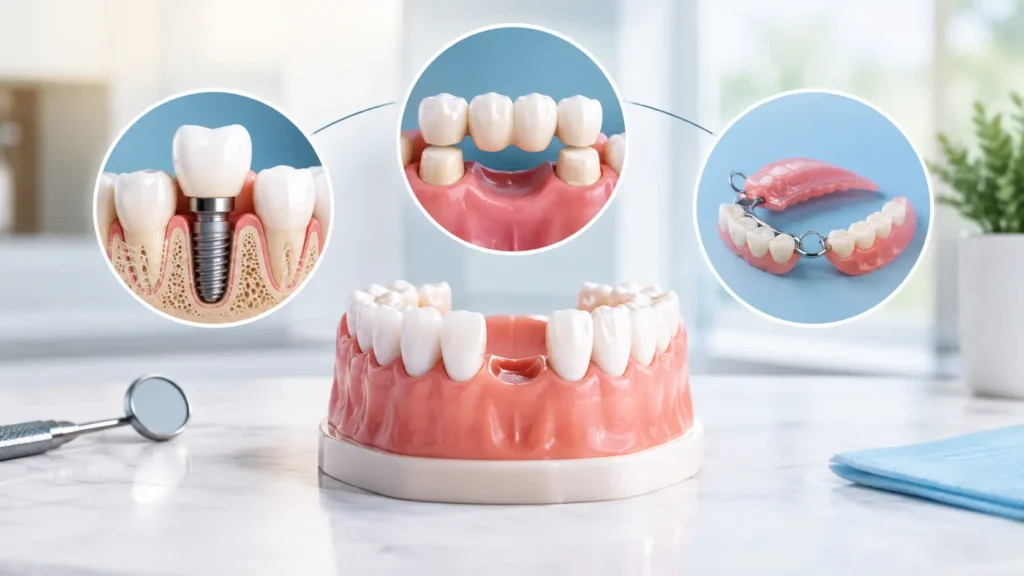
The three main ways to replace a missing tooth are dental implants, dental bridges, and dentures. The right choice depends on how many teeth are missing, the health of your bone and gums, the condition of nearby teeth, your general oral health, your budget, and what you personally want from treatment. A dentist can only confirm the best option after an examination.
Losing a tooth is more common than many people realise, and it can happen for all sorts of reasons: an accident, decay, gum disease, or a tooth that simply couldn’t be saved. Once the initial concern about appearance settles, most patients ask the same practical question: what should I do about the gap? That single question tends to open up three very different paths — a dental implant, a dental bridge, or a denture — and it’s easy to see why people feel unsure about which one is right.
A missing tooth is not always an emergency, but it is worth addressing. The gap can change how you bite and chew, and over time it may affect neighbouring teeth. That said, there is no universal “correct” answer here. What works well for one patient’s mouth may not suit another, because factors like bone density, gum condition, and even how many teeth are missing all shift the recommendation. This guide walks through what each option involves, how they compare, and the questions worth raising with your dentist before deciding.
This article is written to give you a clear, honest starting point — not to steer you toward one treatment. By the end, you should understand the basic mechanics of implants, bridges and dentures, and feel ready to have an informed conversation with a dental professional about your own situation.
What Is the Best Way to Replace a Missing Tooth?
There is no single “best” way to replace a missing tooth that applies to everyone. Dental implants, bridges and dentures each replace a missing tooth in a different way, and the most suitable option depends on your bone health, the number of teeth missing, and your treatment goals. A dental assessment is the only reliable way to know which option fits your case.
- Dental implants are fixed into the jaw and are the only option that replaces the tooth root itself, not just the visible crown.
- Dental bridges replace one or more missing teeth by anchoring a replacement tooth to the adjacent natural teeth.
- Dentures are removable appliances that can replace a single tooth (partial denture) or a full arch of teeth (complete denture).
Because each option has different requirements and trade-offs, the appropriate choice requires a proper dental assessment rather than a general recommendation found online.
Dental Implant vs Bridge vs Denture: Quick Comparison Table
The table below offers a simple side-by-side look at how the three options generally differ. Individual cases can vary, so treat this as a starting point for discussion rather than a final answer.
| Feature | Dental Implant | Dental Bridge | Denture |
|---|---|---|---|
| Removable? | No, fixed in place | No, fixed in place | Yes, removable |
| Replaces tooth root? | Yes | No | No |
| Suitable for one missing tooth? | Often, subject to assessment | Yes, commonly used | Yes, with a partial denture |
| Suitable for multiple missing teeth? | Yes, with multiple implants or an implant-supported bridge | Limited to a short span | Yes, well suited to several or all teeth |
| Treatment process | Surgical placement, healing period, then crown | Preparing adjacent teeth, then fitting the bridge | Impressions and fitting, no surgery |
| Typical maintenance | Brushing, flossing, regular check-ups | Cleaning under and around the bridge | Daily removal and cleaning |
| Longevity | Can last many years with proper care | Can last many years with proper care | May need periodic adjustment or replacement |
| Main advantages | Stable, does not rely on other teeth, preserves function | Fixed in place, faster than implant treatment | Non-surgical, often more accessible cost-wise |
| Main limitations | Requires adequate bone, surgical procedure, healing time | Involves altering adjacent healthy teeth | Removable, may feel less stable than fixed options |
| Cost considerations | Depends on case complexity and any bone work needed | Depends on materials and number of teeth involved | Generally lower upfront cost, may need replacement over time |
Dental Implants for Missing Teeth
A dental implant is designed to replace both the root and the crown of a missing tooth. It consists of three parts: a small titanium post that is placed into the jawbone, an abutment that connects the post to the visible tooth, and a dental crown that sits on top and looks like a natural tooth.
The general treatment stages usually include:
- An initial assessment, including a clinical examination and imaging, to check bone volume and overall suitability.
- Placement of the implant post into the jawbone under local anaesthesia.
- A healing period during which the bone integrates with the implant post.
- Attachment of the abutment and fitting of the final crown once healing is confirmed.
Healing time varies from patient to patient and depends on bone quality, gum health, and whether any additional procedures, such as bone grafting, are needed. Patients with sufficient bone density and healthy gums are often considered reasonable candidates, but this can only be confirmed through a clinical assessment.
Potential advantages of implants include a fixed, independent replacement that does not rely on neighbouring teeth, and a natural feel during everyday chewing. Potential limitations include the need for a surgical procedure, a period of healing, and suitability that depends on adequate bone volume. Maintenance is similar to caring for natural teeth: regular brushing, flossing and dental check-ups.
Is a Dental Implant a Permanent Replacement for a Missing Tooth?
Dental implants are often described as a long-term tooth replacement option, and many patients keep them for many years with good oral hygiene and regular dental visits. However, “permanent” should not be understood as an absolute guarantee — like natural teeth, implants can be affected by gum health, bite forces, and general wear over time, and long-term success depends on proper care and follow-up. A dentist can explain realistic expectations based on your specific case.
Dental Bridges for Missing Teeth
A dental bridge replaces one or more missing teeth by placing an artificial tooth between two supporting teeth, known as abutment teeth. In a traditional bridge, the abutment teeth on either side of the gap are prepared and fitted with crowns that hold the replacement tooth firmly in place, creating a fixed, non-removable structure.
A bridge may be considered when the adjacent teeth are already in need of crowns, when a patient prefers a fixed solution but is not a candidate for implants, or when a shorter treatment timeline is a priority. Advantages include a fixed feel similar to natural teeth and a process that is generally quicker than implant treatment. Limitations include the need to prepare and adjust the healthy neighbouring teeth, and the fact that a bridge does not replace the tooth root, which means the underlying bone is not supported in the same way an implant supports it.
Maintenance involves careful cleaning under and around the bridge, often using floss threaders or interdental brushes, along with regular dental visits to monitor the supporting teeth.
Can a Dental Bridge Replace One Missing Tooth?
Yes, a dental bridge is a common and effective way to replace a single missing tooth, provided the teeth on either side of the gap are healthy enough to support it. Your dentist will check whether those adjacent teeth are strong enough, and whether preparing them for crowns is an appropriate trade-off in your specific case.
Dentures for Missing Teeth
Dentures are removable appliances used to replace missing teeth. A partial denture replaces one or several missing teeth while natural teeth remain in the mouth, and it typically clips or rests onto the surrounding teeth for stability. A complete denture is used when all teeth in an arch are missing and rests directly on the gums.
Dentures may be a useful option for patients who prefer a non-surgical solution, who are missing several teeth across the arch, or for whom implants or a bridge are not currently suitable. Advantages include being non-surgical and, in many cases, more accessible in terms of upfront cost. Limitations include the fact that they are removable, may require an adjustment period to get used to speaking and eating, and can sometimes feel less stable than fixed alternatives.
New denture wearers often need some time to adapt; mild discomfort or minor speech changes in the first few weeks are common and usually settle as the mouth adjusts. Dentures need to be removed and cleaned daily and should be checked periodically by a dentist, since the fit of a denture can change as the gums and underlying bone naturally reshape over time.
For patients who want a removable denture with noticeably more stability, an implant-supported denture is sometimes considered. This approach uses a small number of implants to anchor the denture in place, combining some of the retention benefits of implants with the practicality of a removable appliance. Whether this is appropriate again depends on bone health and an individual assessment.
Can Dentures Replace One Missing Tooth?
Yes, a removable partial denture can replace a single missing tooth, and this is sometimes used as an interim solution while a patient decides on a longer-term option, or as a standalone choice in certain cases. That said, for a single missing tooth, a bridge or an implant is more commonly considered because they are fixed in place; a dentist can explain which prosthetic option best fits your circumstances.
Dental Implant vs Bridge vs Denture: Which Is Better?
Rather than one option being universally “better,” each tends to suit different circumstances:
- Stability: Implants are fixed directly into bone and tend to feel the most stable during chewing. Bridges are also fixed but rely on the supporting teeth. Dentures are removable and, without implant support, generally offer less stability.
- Appearance: All three can be designed to look natural, though the final result depends on the materials used and the skill of the treatment planning.
- Function: Implants most closely mimic the function of a natural tooth root. Bridges function well for chewing but do not stimulate the bone beneath them. Dentures restore function but may feel less secure for some patients, especially with harder foods.
- Tooth preparation: Implants do not require altering neighbouring teeth. Bridges require preparing the adjacent teeth. Dentures generally do not require permanent alteration of other teeth.
- Removability: Implants and bridges are fixed. Dentures are removable and must be taken out for cleaning.
- Treatment time: Bridges and dentures are typically completed sooner than implants, which require a healing period before the final crown is placed.
- Long-term considerations: Implants can help maintain jawbone volume at the site of the missing tooth. Bridges and dentures do not directly address the bone beneath the gap in the same way.
- Cost considerations: Costs vary widely based on the complexity of each case and are discussed in more detail later in this article.
If you are also considering restoring an existing damaged tooth rather than replacing a missing one, it may help to read about the difference between
If you are also weighing whether to restore a damaged tooth rather than replace a missing one, it may help to read our comparison of dental crowns vs veneers, which explains when each restorative approach is used.
How Do I Choose the Right Tooth Replacement Option?
A dentist typically weighs several factors together before recommending a treatment, including:
- The number of missing teeth and where they are located in the mouth
- The volume and quality of the available jawbone
- The health of the gums and any history of gum disease
- The condition of the teeth next to the gap, if a bridge is being considered
- Your bite and how the teeth meet when you chew
- Your day-to-day oral hygiene habits and ability to maintain the chosen option
- Your general health and any conditions that could affect healing
- What you personally expect from treatment, including appearance and comfort
- Your budget and what you are able to invest in treatment
- How much time you have available for the treatment process
- Whether you have a preference for a fixed solution or are comfortable with a removable one
If several teeth are missing or the case involves more extensive rehabilitation, it may also be worth reading about
For patients missing several teeth or facing more complex dental needs, it can also help to understand full mouth rehabilitation, which covers cases where multiple treatments are combined into a single plan.
What Happens If You Do Not Replace a Missing Tooth?
The effect of leaving a missing tooth untreated varies from person to person, and not every patient experiences the same changes. That said, there are some possible concerns worth being aware of:
- Chewing on the affected side may become less comfortable or less efficient
- Neighbouring teeth can gradually shift or tilt toward the empty space
- The bite may change over time as teeth move to fill the gap
- Food can become more likely to trap in or around the gap
- Cleaning the area thoroughly can become more difficult in some cases
- The jawbone in the area of the missing tooth may change in volume over time
It is worth being cautious about broad claims such as “a missing tooth will always lead to bone loss or facial collapse.” These outcomes are possible in some cases but are not universal or automatic, and the extent of any change depends on individual factors. If you are unsure whether your situation needs prompt attention, a dental check-up can clarify this without any pressure to commit to a specific treatment.
How Much Does It Cost to Replace a Missing Tooth in Islamabad?
There is no fixed, one-size-fits-all price for replacing a missing tooth, and it would be misleading to quote a specific figure without an examination. Instead, the cost of treatment depends on a combination of factors, including:
- The type of treatment chosen — implant, bridge, or denture
- The number of teeth being replaced
- The materials used for the crown, bridge, or denture
- The implant system used, where an implant is involved
- The condition of the jawbone, and whether bone grafting is required
- Any laboratory work needed to fabricate the final restoration
- The overall complexity of the case, including the health of gums and surrounding teeth
- Follow-up visits and any adjustments required after treatment
Because dental implant cost in Islamabad, dental bridge cost in Islamabad, and dentures cost in Islamabad can all vary significantly between cases, it is generally more useful to compare complete treatment plans from a clinic rather than comparing a single advertised price. A treatment plan that looks less expensive at first glance may not include imaging, follow-up visits, or the materials you actually need, so ask for a written breakdown before deciding.
How Long Does It Take to Replace a Missing Tooth?
Treatment timelines differ by option and by individual healing, so the following are general descriptions rather than fixed schedules:
- Dental implant: Typically involves an initial placement procedure followed by a healing period before the final crown is fitted. The overall timeline depends on bone healing and whether any additional procedures are needed.
- Dental bridge: Generally completed over a small number of visits once the adjacent teeth are prepared and the bridge is fabricated and fitted.
- Denture: Usually involves impressions, try-in fittings, and a final fitting, without a surgical healing period.
Factors such as bone condition, gum health, whether extractions are needed beforehand, and individual healing speed can all extend or shorten these timelines. Your dentist can give you a realistic estimate once your specific case has been assessed.
Is Replacing a Missing Tooth Painful?
Most tooth replacement procedures are carried out under local anaesthesia, which numbs the treatment area during the procedure itself. Some treatments, particularly implant placement, may involve temporary soreness or sensitivity for a few days afterward as the area heals, and this is generally manageable with the aftercare guidance your dentist provides.
Recovery experiences vary by treatment type and by individual, so it would not be accurate to describe any procedure as completely painless. Following your dentist’s aftercare instructions, such as guidance on diet, oral hygiene, and any prescribed medication, plays an important role in a comfortable recovery.
Replacing Missing Teeth in Islamabad and Rawalpindi
Patients in Islamabad, Rawalpindi and nearby areas have a number of options when it comes to missing tooth treatment, which can make the decision feel overwhelming. Rather than focusing only on price, it helps to look for a few markers of quality care:
- A proper diagnosis based on a clinical examination, not a quick visual guess
- Qualified dental professionals involved in your assessment and treatment
- Appropriate imaging, such as X-rays, used when relevant to plan treatment safely
- A personalised treatment plan rather than a one-size-fits-all recommendation
- A clear explanation of the available options, including why one is being recommended over another
- Transparent discussion of expected costs before treatment begins
- Proper follow-up and aftercare once treatment is complete
At Lumino Dental Clinic, patients from Islamabad, Rawalpindi and surrounding areas are welcome to come in for an assessment to discuss tooth replacement options in more detail. The right recommendation always follows an examination of your teeth, gums and bone, rather than a generic answer given without seeing your mouth.
Frequently Asked Questions
What is the best way to replace a missing tooth?
There is no single best way for everyone. Dental implants, bridges and dentures each replace a missing tooth differently, and the most suitable option depends on your bone health, the number of missing teeth, and your personal goals. A dental assessment is needed to determine which is right for you.
What is better, a dental implant or a bridge?
Neither is universally better; they suit different situations. Implants replace the tooth root and do not involve altering neighbouring teeth, while bridges are fixed in place faster but require preparing the adjacent teeth for support. Your dentist can advise based on your bone health and the condition of nearby teeth.
Can a missing tooth be replaced without an implant?
Yes. Dental bridges and dentures both replace missing teeth without requiring implant surgery. Each has its own advantages and limitations, and suitability depends on individual factors like the condition of nearby teeth and how many teeth are missing.
Can a dental bridge replace one missing tooth?
Yes, a bridge is a common option for replacing a single missing tooth, provided the teeth on either side of the gap are healthy enough to support it.
Can dentures replace a single missing tooth?
Yes, a removable partial denture can replace one missing tooth, though a bridge or implant is more commonly used for single-tooth gaps because they are fixed rather than removable.
How long does it take to replace a missing tooth?
Timelines vary by treatment. Bridges and dentures are usually completed over a few visits, while implants involve a placement procedure and a healing period before the final crown is fitted. Individual healing time affects the overall schedule.
How long do dental implants last?
Dental implants are often considered a long-term solution and can last many years with good oral hygiene and regular dental check-ups, though long-term success depends on individual care and is not an absolute guarantee.
How long does a dental bridge last?
A well-maintained dental bridge can last many years, particularly with good oral hygiene and regular monitoring of the supporting teeth.
How long do dentures last?
Dentures can last several years, but they may need adjustment or eventual replacement as the shape of the gums and jawbone changes naturally over time.
Is replacing a missing tooth painful?
Procedures are typically performed under local anaesthesia, so discomfort during treatment is minimised. Some soreness afterward is possible depending on the treatment, and following aftercare instructions helps manage recovery.
What happens if I leave a missing tooth untreated?
Effects vary between patients but can include shifting of neighbouring teeth, changes in bite, difficulty cleaning the area, and changes in the jawbone over time. Not every patient experiences the same outcome, so a dental check-up is the best way to understand your specific situation.
How much does it cost to replace a missing tooth in Islamabad?
Costs depend on the treatment type, number of teeth involved, materials used, and case complexity, so there is no fixed price that applies to everyone. It is best to request a written treatment plan and cost breakdown after an assessment.
Are dental implants suitable for everyone?
Not necessarily. Implant suitability depends on factors such as bone volume, gum health, and general health. A dentist can determine candidacy through an examination and, if needed, imaging.
Which is more affordable: an implant, bridge or denture?
Dentures often have a lower upfront cost, while bridges and implants can vary depending on materials and complexity. However, comparing complete treatment plans, rather than upfront price alone, gives a more accurate picture of long-term value.
Can I eat normally after replacing a missing tooth?
Most patients return to normal eating after an adjustment period, which varies by treatment. Fixed options like implants and bridges often feel closer to natural teeth, while new denture wearers may need time to adjust to certain foods.
How do I know which tooth replacement option is right for me?
The right option depends on your bone health, gum condition, number of missing teeth, budget, and personal preferences. A dental examination is the only reliable way to get a recommendation tailored to your mouth.
Ready to Discuss Your Options?
If you have a missing tooth and are unsure whether an implant, bridge or denture is right for you, a dental examination can help determine the most suitable option for your teeth, gums and overall oral health. Every mouth is different, and the right recommendation comes from looking at your specific case rather than a general guide.
Patients in Islamabad, Rawalpindi and nearby areas are welcome to contact Lumino Dental Clinic in F8 and D12 Islamabad to book a consultation and discuss which tooth replacement option best fits their needs.