Choosing a crown, veneer or filling used to come down to two questions: how will it look, and how long will it last. Today a third question sits alongside those two — what is this material actually made of, and what happens to it once it leaves the lab.
Material selection in cosmetic and restorative dentistry now touches function, durability, tissue response, aesthetics, day-to-day maintenance and, increasingly, environmental impact. Zirconia, glass ceramics, composite resin and digital manufacturing have changed what a crown or veneer can look and feel like, and they have changed how much material, energy and waste a restoration produces along the way.
This guide separates what current research actually supports from what is still developing, and explains two terms that get used almost interchangeably online but describe very different things: biocompatibility and sustainability. Patients in Islamabad, Rawalpindi and nearby sectors researching cosmetic dental treatment will find plain-English explanations of each material category, how dentists weigh the trade-offs, and what questions are worth asking before you commit to a treatment plan.
What are biocompatible and sustainable dental materials?
Biocompatible dental materials are materials clinically shown to interact safely with oral tissue, with a low risk of irritation or adverse reaction. Sustainable dental materials are materials and workflows evaluated for their environmental footprint, from raw-material sourcing through manufacturing, use and disposal. The two ideas overlap in modern cosmetic dentistry, particularly through ceramics, zirconia and digital CAD/CAM workflows, but a material can be biocompatible without being especially sustainable, and vice versa. Your dentist selects the right material based on your tooth, bite and goals, not on a single label.
What Are Biocompatible Dental Materials?
A biocompatible dental material is one that has been studied for how it interacts with living oral tissue — gums, bone, saliva and the tooth structure itself — and shown to carry a low risk of irritation, toxicity or allergic reaction under normal clinical use. Biocompatibility is tested through laboratory (in vitro) work on cell cultures, animal (in vivo) studies, and long-term clinical monitoring of real restorations in real mouths.
Zirconia is one of the most extensively studied examples. Research reviewing zirconia’s interaction with bone and muscle tissue has found no adverse response to the material, and cell-culture studies have generally shown good cell viability with no evidence of induced mutation, which is part of why the same ceramic is also used in orthopedic implants such as hip components. Separate literature reviews of zirconia dental implants report that some in vivo studies found a smaller inflammatory response around zirconia than around titanium, alongside favorable soft-tissue behavior and low plaque affinity.
Biocompatibility is not a single yes-or-no property, though. It depends on the specific material formulation, how it is processed and finished, where in the mouth it is placed, and the individual patient’s tissue response, medical history and any known sensitivities. A material can be well tolerated by the large majority of patients and still be unsuitable for a specific person or a specific clinical situation — which is why “biocompatible” describes a body of supporting evidence, not a guarantee.
What Are Sustainable Dental Materials?
Sustainability in dentistry is a lifecycle question rather than a single material property. It covers how a material or product is sourced, how much energy and water its manufacturing consumes, how far it travels before reaching the clinic, how much of it ends up as waste during preparation, and how it is disposed of once a restoration or its packaging reaches the end of its use.
A narrative review of sustainable dental and periodontal practice frames this through a “4R” lens — reduce, reuse, rethink and recycle — applied to everything from single-use plastics and packaging to water use and clinical waste streams, not to restorative materials alone. Digital workflows sit at the center of most sustainability discussions in dentistry today, because intraoral scanning and CAD/CAM design remove the need for some physical impression materials and reduce shipping between the clinic and an external lab.
It is worth being precise here: labeling something “eco-friendly” is not the same as demonstrating a measurably lower environmental footprint across its full lifecycle. Digital manufacturing has real, documented advantages in some areas, and real trade-offs in others — subtractive CAD/CAM milling of ceramics, for instance, has been identified as a source of fine particulate and microplastic contamination in the water used during machining, and it typically generates significant off-cut material. Sustainability claims in dentistry deserve the same scrutiny as any other environmental claim, evaluated case by case rather than assumed from a material category.
Why Are Dental Materials Changing?
Dental materials have changed for reasons that mostly have nothing to do with sustainability at all — they have changed because digital tools made restorations more precise and more repeatable. CAD/CAM systems allow a dentist to scan a prepared tooth, design a restoration on-screen and either mill it chairside or send the file directly to a lab, often replacing multiple physical steps with one digital one.
Ceramic science has advanced alongside the digital tools. Zirconia formulations have improved in both strength and translucency over the past decade, closing much of the aesthetic gap that once made metal-ceramic crowns look duller than natural teeth. Bonding systems and resin cements have also improved, which affects how well a ceramic or composite restoration adheres to the tooth and, in turn, how long it lasts.
Put together, these changes mean today’s restorations tend to require less removal of healthy tooth structure, fit more precisely, and are engineered for a narrower range of clinical uses rather than one material trying to do every job. That specialization is part of why a modern treatment plan often names a specific ceramic or composite type rather than a generic “crown” or “filling.”
The Rise of Biocompatible Materials in Cosmetic Dentistry
Ceramic Materials
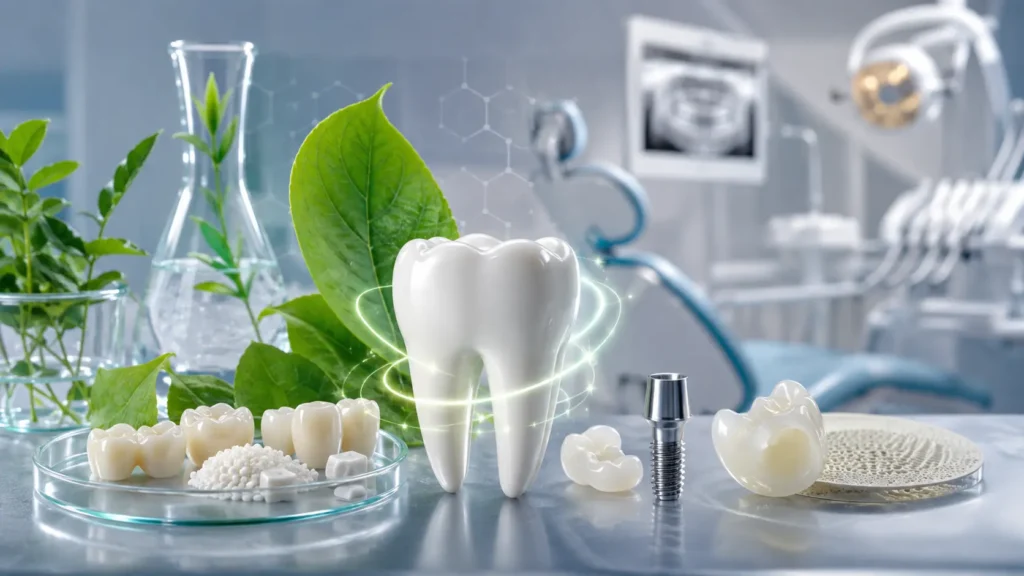
Dental ceramics cover a family of materials rather than one substance, and each type is suited to different situations. What they share is a natural, tooth-like appearance and a track record of being well tolerated by oral tissue, which is why ceramics dominate visible, front-of-mouth restorations such as veneers and anterior crowns.
Zirconia
Zirconia is the strongest of the commonly used dental ceramics, which is why it shows up in molar crowns, bridges and implant-supported restorations that need to withstand heavy chewing forces. Research on its mechanical performance has found zirconia fixed partial dentures to outperform other ceramic and composite restorations under load, supporting its use in implant-supported rehabilitation.
Its biocompatibility profile is one of the most researched of any dental material, as covered above — but zirconia also has limitations that matter in practice. Very high translucency zirconia trades some strength for aesthetics, so a dentist balances the two depending on whether the restoration sits at the back of the mouth (where strength matters more) or the front (where light transmission and shade-matching matter more). Case selection, not the material alone, determines the outcome.
Glass Ceramics
Glass ceramics, including lithium disilicate, are prized for how closely they mimic the way natural enamel transmits light, which makes them a common choice for veneers and anterior crowns where appearance is the priority. They are not as fracture-resistant as zirconia, so they are typically reserved for lower-load areas or used with careful attention to bite forces and tooth preparation.
Composite Resin
Composite resin is a tooth-colored, plastic-and-ceramic-particle material bonded directly to the tooth, most often used for fillings, minor cosmetic reshaping and some veneers. Its biggest clinical advantage is conservation of healthy tooth structure — because it bonds directly, less of the natural tooth needs to be removed compared with some indirect restorations.
Research on composite longevity gives a realistic picture rather than a uniform answer: reviews of long-term clinical studies report annual failure rates for direct composite restorations ranging broadly from under 1% to over 6%, with most well-conducted studies clustering in the 1–4% range and posterior composites often showing survival above 90% at five years. Secondary decay, chipping and fracture are the most common reasons a composite restoration eventually needs replacement, and outcomes depend heavily on placement technique, oral hygiene and bite forces — not on the material in isolation.
Compared with older amalgam fillings, one systematic review found composite restorations had a shorter median survival time in posterior teeth, largely due to a higher rate of secondary caries, while amalgam’s own decline in use is driven by different factors entirely — international mercury policy, covered below, rather than a simple durability contest.
Other Emerging and Bioactive Materials
Bioactive materials, which are designed to interact chemically with tooth structure — for example, by releasing ions that support remineralization — are an active area of dental research. Evidence for some formulations is encouraging, particularly for minimally invasive and preventive applications, but the body of long-term clinical data is smaller than what exists for zirconia or conventional composite. Where a bioactive material is genuinely appropriate, a dentist will usually explain it as a specific option for a specific situation rather than a universal upgrade, and patients should treat marketing claims about “self-healing” or “regenerative” materials with the same caution as any other unproven claim.
Biocompatibility vs Sustainability
Biocompatibility and sustainability get discussed together so often that they can start to sound like the same idea. They are not, and conflating them can lead to a restoration chosen for the wrong reason.
| Factor | Biocompatibility | Sustainability |
|---|---|---|
| Main concern | Biological response of tissue | Environmental impact over time |
| Focus | Patient / tissue interaction | Lifecycle: sourcing to disposal |
| Key considerations | Tissue response, allergies, irritation, clinical suitability | Manufacturing, waste, energy, water, disposal |
| Evidence type | In vitro, in vivo and clinical studies | Life-cycle assessment and practice audits |
| Same concept? | No – a separate question from sustainability | No – a separate question from biocompatibility |
How Sustainable Is Modern Cosmetic Dentistry?
Digital workflows are the most consistently documented sustainability improvement in modern dental practice. Intraoral scanning removes the need for some traditional impression materials — alginate and polyvinyl siloxane among them — which are single-use, generally not biodegradable and require energy-intensive manufacturing. Several published comparisons report that digital workflows can reduce material waste by roughly half compared with fully analog lab processes, largely by cutting out physical models, shipping and remakes caused by inaccurate impressions.
That said, digital manufacturing is not automatically the lower-impact choice in every respect. Subtractive CAD/CAM milling — the process of carving a crown out of a solid ceramic block — is efficient in time and precision but wasteful in material, with a meaningful share of each zirconia block ending up as off-cut. Researchers are exploring recycling of zirconia powder from milling waste, and additive manufacturing (3D printing) is being studied as a lower-waste alternative to milling for some applications, though it has not replaced subtractive CAD/CAM as the clinical standard.
Beyond the operatory, sustainability in a dental practice also touches ordinary operational choices: reducing single-use plastics, using amalgam separators and dry vacuum systems to limit wastewater contamination, sourcing recyclable packaging, and adopting paperless records. None of these choices are exclusive to cosmetic dentistry, but they add up across a busy clinic, and a genuinely sustainability-minded practice tends to address all of them rather than pointing to one material as proof of a green commitment.
Are Sustainable Dental Materials Better for Patients?
Environmental sustainability and clinical performance are two separate scorecards, and a material that scores well on one does not automatically score well on the other. A digitally milled zirconia crown may have a lower manufacturing footprint than a conventionally cast metal-ceramic crown, but the deciding factor in whether it is the right choice for a specific tooth is still whether it can withstand that patient’s bite forces, fit the remaining tooth structure and meet the aesthetic goal.
Material selection should weigh the condition of the tooth and surrounding gum tissue, the functional demands of that position in the mouth, aesthetic priorities, expected longevity, any known sensitivities, and how much upkeep the patient is realistically able to commit to. A sustainability-conscious workflow can sit alongside any of those decisions — it does not replace them.
How Dentists Choose the Right Dental Material
Dentists rarely pick a restorative material off a fixed list. A working decision process generally moves through the following considerations:
- Assess overall oral health, including gum condition and any active decay or infection
- Evaluate how much healthy tooth structure remains to work with
- Determine the functional demands of the tooth — a molar under heavy bite force is judged differently from a front tooth
- Weigh aesthetic priorities, especially for visible teeth
- Compare the mechanical and biological properties of candidate materials for that specific case
- Consider expected longevity and realistic maintenance
- Factor in the patient’s own preferences and, where appropriate, sustainability considerations
- Select the restoration that best balances all of the above — not simply the newest option available
There is no single “best” dental material across every case. A material that is an excellent choice for a molar crown may be the wrong choice for a thin anterior veneer, and a material that performed well in a published study still has to suit the specific tooth in front of the dentist.
The Future of Cosmetic Dentistry
Several developments look likely to keep shaping cosmetic and restorative dentistry over the coming years, though it is worth separating what is already in routine clinical use from what remains experimental.
Advanced ceramic formulations continue to narrow the trade-off between strength and translucency, and CAD/CAM design software increasingly incorporates AI-assisted tools to help plan restorations and predict fit before milling begins. Additive manufacturing — 3D printing of surgical guides, models and, increasingly, some restorative components — is expanding, partly because it produces less waste than subtractive milling for certain applications. Bioactive and minimally invasive materials are an active research area, though as noted above, their long-term clinical evidence base is still growing.
On the environmental side, recycling of zirconia milling waste, more efficient digital workflows and continued movement away from mercury-containing amalgam are the clearest near-term trends. The Minamata Convention on Mercury — an international treaty that Pakistan and more than 100 other countries have ratified — set a global phase-out date of 2034 for the manufacture, import and export of dental amalgam at its sixth Conference of the Parties in late 2025, building on restrictions already in effect since 2023 for children and pregnant women. That shift is driven primarily by mercury’s environmental and public-health profile rather than amalgam’s clinical performance, which several long-term studies have actually rated highly for durability.
None of this means every emerging technology belongs in every treatment plan today. The materials with the strongest evidence base — well-established zirconia and glass-ceramic formulations, and conventional composite resin — remain the backbone of most cosmetic and restorative work, with newer options layered in where the evidence and the clinical situation both support it.
What This Means for Patients
Understanding the material behind a recommendation turns a passive decision into an informed one. Before agreeing to a crown, veneer, bridge or filling, it is reasonable to ask your dentist:
- What material are you recommending, and why is it appropriate for this specific tooth?
- How long is this restoration expected to last under normal use?
- What are the alternative materials, and what would change with each one?
- What are the advantages and limitations of this option for my case?
- Is this material suitable for my bite and any grinding or clenching habits?
- How does this restoration balance appearance with function?
- Are there more conservative options that preserve additional tooth structure?
A dentist who can answer these clearly, and who explains trade-offs rather than promising a single “best” material for everyone, is giving you the information needed to make a confident decision — whether that decision involves a routine filling or a full cosmetic smile plan.
Cosmetic Dentistry in Islamabad: What to Look For
For patients weighing cosmetic dentistry in Islamabad, these material questions come up in nearly every consultation, whether the starting point is a chipped front tooth, a discolored old filling, or a full set of veneers. A modern dental clinic in Islamabad working with CAD/CAM design, current ceramic systems and evidence-based material selection is generally working from the same research base described throughout this guide, adapted to each patient’s tooth structure, bite and aesthetic goals. If gum health has not been assessed recently, it is worth reviewing the warning signs of gum disease before committing to cosmetic treatment, since healthy gum tissue is part of what supports a long-lasting cosmetic restoration. Similarly, if a tooth is damaged rather than simply discolored, understanding whether a tooth can be saved with root canal treatment or requires extraction is a separate but related decision that often comes before any cosmetic material discussion begins.
FAQs
What are biocompatible dental materials?
Biocompatible dental materials are materials shown through laboratory and clinical research to interact safely with oral tissue, with a low likelihood of causing irritation, toxicity or allergic reaction. Zirconia, glass ceramics and composite resin all have supporting biocompatibility research, though individual patient response can still vary.
Are ceramic dental materials biocompatible?
Most dental ceramics, including zirconia and lithium disilicate, have substantial published research supporting good tissue tolerance and biocompatibility. As with any dental material, suitability still depends on the specific formulation and the individual patient’s clinical situation.
Is zirconia a biocompatible dental material?
Yes. Zirconia is one of the most extensively studied dental materials for biocompatibility, with in vivo research showing no adverse tissue response and in vitro studies showing good cell viability. It is also used in orthopedic implants for similar reasons.
Are sustainable dental materials safe?
Sustainability and clinical safety are evaluated separately. A material chosen for a lower environmental footprint still needs to meet the same biocompatibility and performance standards as any other dental material — one does not guarantee the other.
What is the most environmentally friendly dental material?
There is no single material that current evidence identifies as the most environmentally friendly across every use case. Environmental impact depends on manufacturing method, waste generated during preparation, transportation and disposal, and this varies by product, supplier and workflow rather than by material category alone.
Are composite fillings environmentally friendly?
Composite fillings avoid the mercury-related environmental concerns associated with amalgam, but they are petroleum-derived and their full lifecycle footprint has not been as extensively studied as some other materials. They should be evaluated on clinical fit for the patient first.
What materials are commonly used for cosmetic dental restorations?
Common materials include zirconia, lithium disilicate and other glass ceramics, and composite resin, each suited to different combinations of strength, aesthetics and location in the mouth.
Is digital dentistry more sustainable?
Digital workflows, including intraoral scanning and CAD/CAM design, have been shown in several studies to reduce material waste and shipping-related impact compared with fully analog processes, though subtractive milling still generates ceramic waste that researchers are working to reduce through recycling and alternative manufacturing methods.
How do dentists choose dental materials?
Dentists weigh oral health, remaining tooth structure, functional demands, aesthetic goals, material properties, expected longevity and patient preference, selecting the restoration that best fits that specific case rather than defaulting to one material for every patient.
What is the future of sustainable dentistry?
Near-term developments include continued adoption of digital workflows, zirconia waste recycling research, expanding use of additive manufacturing for some applications, and the ongoing global phase-out of dental amalgam under the Minamata Convention, with a 2034 deadline agreed by treaty parties.
Can sustainable dentistry improve patient care?
Sustainable workflows, such as digital impressions and CAD/CAM design, often improve precision and reduce remakes, which can indirectly benefit patient experience — but the primary basis for any material recommendation should remain clinical suitability, not environmental impact alone.
Should I ask my dentist about biocompatible materials?
Yes. Asking what material is being recommended and why it suits your specific tooth is a reasonable question for any restorative or cosmetic treatment, and a dentist should be able to explain the reasoning in plain terms.
Considering Cosmetic Dental Treatment?
The right material for your case depends on your tooth structure, bite, aesthetic goals and long-term treatment plan — not simply which material is newest or most talked about. At Lumino Dental & Aesthetics Clinic, our team can assess your oral condition and walk through appropriate restorative and cosmetic options based on your individual needs, explaining the reasoning behind each recommendation.
If you are ready to discuss your options, schedule a consultation with our dental team to get a treatment plan built around your specific case, not a generic protocol.