If you’ve started looking into orthodontic treatment in Islamabad or Rawalpindi, you’ve probably noticed that almost every dental clinic offers both clear aligners and traditional braces, and almost none of them tell you which one you actually need. That’s not an accident. The honest answer depends on your teeth, not on a marketing preference.
Choosing between braces and clear aligners isn’t really about looks, even though appearance is usually the first thing people ask about. It comes down to how your teeth need to move, how your bite fits together, and whether you can commit to wearing a removable device for 20-plus hours a day. Some cases are straightforward. Others need the kind of control that only a fixed appliance can give.
This article walks through the real differences between the two teeth straightening options, where each one tends to work well, and what a dentist or orthodontist will actually look at before recommending one over the other.
There’s no universal winner between clear aligners and braces. Clear aligners suit patients wanting a removable, discreet option, best for mild-to-moderate crowding, spacing, or bite issues. Braces suit complex tooth movements needing precise, continuous control. The right choice depends on an orthodontic assessment of your specific case, not personal preference alone.
Key takeaways:
- Clear aligners are removable, nearly invisible, and best suited to mild-to-moderate cases.
- Traditional braces (metal or ceramic) are fixed and generally handle complex or severe cases more reliably.
- Compliance matters more with aligners — inconsistent wear extends treatment time.
- Cost and treatment length both depend on case complexity, not the appliance type alone.
- A dental consultation and bite assessment, not a general comparison, determines which option fits you.
Clear Aligners vs Braces: What’s the Difference?
Braces and clear aligners both move teeth by applying steady, controlled pressure — that part is the same. What differs is how that pressure gets delivered.
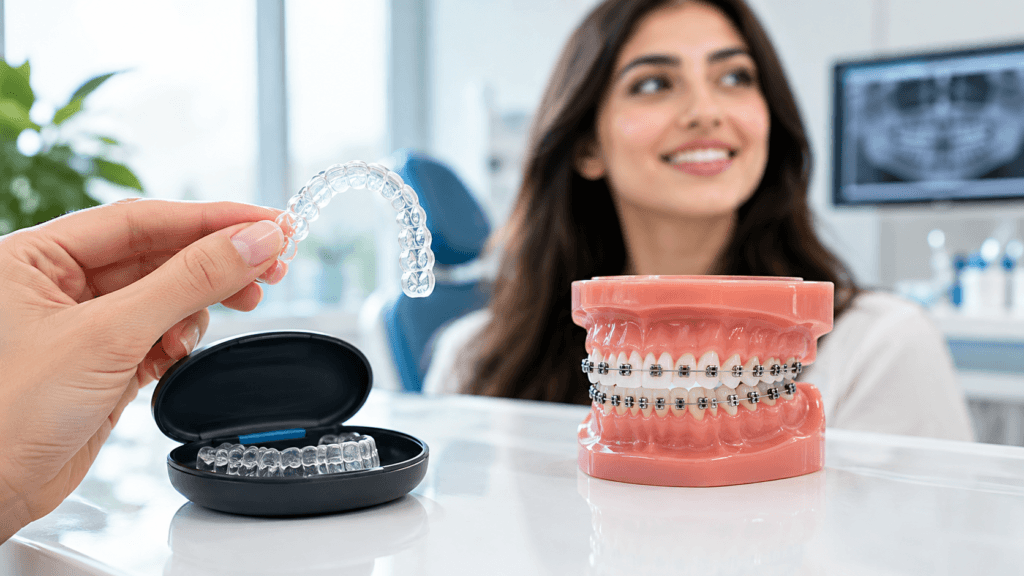
Traditional braces use brackets bonded to each tooth, connected by an archwire. The wire is adjusted periodically to guide teeth into position, and because the appliance is fixed, it’s working around the clock without you needing to do anything except keep it clean and show up for appointments.
Clear aligners are a series of custom-made, transparent plastic trays. Each tray in the series shifts your teeth slightly, and you move to the next one every one to two weeks (your dentist will tell you the exact schedule for your case). They’re removable, which is the main reason people find them appealing, but that removability only works in your favor if you’re disciplined about putting them back in.
Both approaches fall under orthodontics, the branch of dentistry concerned with correcting misaligned teeth and jaws, and both require a dentist or orthodontist to plan the movement before treatment starts. Beyond these two, there isn’t really a third mainstream category — when people search for orthodontic treatment options or the best way to straighten teeth, they’re almost always comparing some version of aligners versus braces.
How Do Clear Aligners Work?
A clear aligner treatment plan usually starts with digital scans or impressions of your teeth. From those, a lab produces a series of aligner trays, each one a small step toward the final position. As you progress through the series, your teeth gradually shift.
Because the trays are removable, you take them out to eat and to brush and floss, then put them back in. Most aligner systems require somewhere close to 20 to 22 hours of wear per day to stay on track. Wearing them less than that is one of the most common reasons aligner treatment takes longer than planned or produces less predictable results.
Aligners tend to work well for people with mild to moderate crowding, gaps between teeth, or certain bite issues. More complex movements, like significant rotations of round teeth (canines and premolars, for example) or major vertical repositioning, are harder for aligners to manage precisely — though newer aligner systems with attachments have expanded what’s possible.
How Do Traditional Braces Work?
Braces rely on a fixed appliance that stays on your teeth throughout treatment. Brackets are bonded to each tooth and connected with an archwire, which is periodically changed or adjusted at follow-up visits — typically every four to eight weeks, though your dentist will set the schedule based on your progress.
Because braces are fixed rather than removable, they don’t depend on patient compliance the way aligners do. This is one reason orthodontists often lean toward braces for more complicated cases: the appliance is working continuously, and the level of control over each tooth’s movement, including rotation, tipping, and vertical position, is generally more precise.
Metal braces remain the standard option, though ceramic braces (tooth-colored brackets) are widely available for patients who want something less visible while keeping a fixed appliance. In practice, the comparison patients are often really making is clear aligners vs metal braces, or clear aligners vs ceramic braces, rather than “braces” as one single option — and each has its own trade-offs on visibility, cost, and durability.
Clear Aligners vs Braces: Side-by-Side Comparison
Here’s how the two compare across the factors patients usually ask about. Treat this as a starting point for a conversation with your dentist, not a final verdict — individual cases vary.
| Factor | Clear Aligners | Traditional Braces |
|---|---|---|
| Appearance | Nearly invisible, clear plastic | Visible metal, or less visible with ceramic |
| Removability | Removable by the patient | Fixed for the full treatment |
| Eating | No food restrictions once removed | Some foods to avoid (sticky, hard, chewy items) |
| Oral hygiene | Easier — brush and floss normally after removing | Requires more care around brackets and wires |
| Comfort | Generally less irritation to soft tissue, mild pressure per tray change | Can cause soreness after adjustments; brackets may irritate cheeks initially |
| Treatment control | Good for milder movements; limited for complex cases | Strong control over complex or multi-directional movement |
| Compliance needed | High — depends on 20+ hours/day wear | Low — appliance works regardless of patient habits |
| Complex cases | May need attachments or may not be suitable | Generally more capable of handling complex cases |
| Follow-up appointments | Periodic check-ins, sometimes less frequent | Regular adjustment visits, typically every 4–8 weeks |
| Lifestyle fit | Convenient for social situations, sports, wind instruments | Fixed appliance present at all times |
| Cost considerations | Varies by case complexity and number of trays | Varies by case complexity and material (metal vs ceramic) |
| Suitability | Best for mild-to-moderate cases per assessment | Suitable across a wider range of case complexity |
Clear Aligners: Advantages and Disadvantages
Aligners are popular for a reason. They’re close to invisible, you can take them out for meals and photos, and cleaning your teeth doesn’t involve maneuvering around wires. For adults especially, the discretion matters — nobody wants to explain a mouth full of metal in a client meeting.
The catch is that all of those advantages depend on you actually wearing the trays as prescribed. Take them out too often, or lose one and delay replacing it, and your treatment timeline slips. Aligners also aren’t the right tool for every case — an orthodontist may tell you that certain rotations or bite corrections are outside what aligner therapy can reliably achieve, at least not without additional attachments or a hybrid approach.
Traditional Braces: Advantages and Disadvantages
Braces have been refined over decades, and that track record shows in how reliably they handle difficult cases — significant crowding, complex bite problems, or teeth that need to move in ways that are hard to program into a series of plastic trays.
Because they’re not removable, braces take the compliance question off the table. Whatever happens, the appliance is doing its job. The trade-off is visibility (even with ceramic brackets, they’re not invisible), some dietary restrictions, and generally more attention needed during brushing and flossing to avoid plaque buildup around brackets.
Clear Aligners vs Braces for Adults
Adults often gravitate toward aligners for the obvious reason: nobody wants visible braces at 35 while running client calls or attending weddings. But suitability still comes down to the case, not the age group. An adult with significant crowding or a bite problem that developed over years may need braces regardless of preference. When people search for the best braces for adults in Islamabad or clear aligners for adults in Islamabad, what they’re usually really asking is which option fits a busy schedule and a case that’s had years to develop — and that’s answered case by case, not by age bracket.
One thing worth mentioning: adults sometimes have more complex orthodontic histories — previous treatment that relapsed, missing teeth, or gum health considerations — which can affect which option is realistic. This is exactly the kind of thing that gets sorted out during a proper consultation rather than guessed at beforehand.
Clear Aligners vs Braces for Teenagers
Teenagers are still going through jaw development, and that can influence treatment planning. Compliance is also a bigger question mark with teens than with adults — a removable aligner is only effective if it’s actually in the mouth for the recommended hours, and that’s harder to guarantee with a 14-year-old than a 40-year-old.
Braces remain common for teenagers partly because of this compliance factor, and partly because many teenage cases involve the kind of crowding or bite development that responds well to fixed appliances. That said, plenty of orthodontists do prescribe aligners for teens who show good discipline, particularly for milder cases.
Clear Aligners vs Braces for Crowded Teeth
Mild to moderate crowding often responds well to aligners. Severe crowding, where teeth are significantly overlapping or there isn’t enough space in the arch, usually needs the kind of controlled, continuous force that braces (sometimes combined with other interventions like extractions or expanders) can provide.
Clear Aligners vs Braces for Gaps Between Teeth
Spacing issues, where there are visible gaps between teeth, are frequently treated successfully with aligners, since closing gaps is one of the more predictable movements aligner trays can manage. Braces can close gaps too, and may be preferred if the spacing is part of a more complex bite issue.
Clear Aligners vs Braces for Bite Problems
Overbite, underbite, crossbite, and open bite all fall under malocclusion — the general term for a bite that doesn’t align correctly. Some milder bite discrepancies can be managed with aligners, particularly with attachments or elastics built into the treatment plan. More significant bite problems often need the mechanical control that braces provide, and in some cases, coordination with other treatment depending on the severity.
Which Is More Comfortable?
Both cause some discomfort. That’s a normal part of teeth actually moving. Aligners tend to produce a duller, shorter-lived pressure sensation each time you switch to a new tray, generally easing off within a day or two. Braces can cause more noticeable soreness after adjustment appointments, and the brackets themselves can irritate the inside of the cheeks and lips, especially in the first couple of weeks before your mouth adjusts. Orthodontic wax helps with that, and most patients say the irritation fades as they get used to the appliance.
Which Is Easier to Clean?
Aligners win here in most cases, simply because you remove them to brush and floss like normal. Braces require more deliberate technique — an interdental brush or floss threader to get under the wire, and closer attention to areas around each bracket where plaque likes to accumulate. Patients with braces who don’t adjust their hygiene routine are more likely to end up with visible marks on the enamel once the brackets come off, so this is worth taking seriously rather than treating as a minor inconvenience.
Which Treatment Takes Less Time?
There’s no fixed number that applies to everyone here, and be wary of any source that gives you one. Treatment length depends on how much movement is needed, how complex the case is, and — with aligners specifically — how consistently the trays are worn. A mild case might resolve faster with aligners; a complex case might actually take longer with aligners than it would with braces, simply because aligners aren’t built for that level of correction and might need to be supplemented or switched to a fixed appliance partway through. Your dentist can give you a realistic estimate once they’ve assessed your teeth, but even that estimate is a starting point, not a guarantee.
Clear Aligners vs Braces: Cost in Islamabad and Pakistan
People searching for clear aligners cost in Islamabad, braces cost in Islamabad, or braces price in Pakistan, are usually hoping for a single number, and it’s worth explaining why that’s not really possible to give responsibly. The same applies to anyone comparing clear aligners Rawalpindi or braces Rawalpindi pricing — location affects which clinics are convenient, but not the underlying cost drivers. Orthodontic pricing depends on:
- the complexity of the case and how much movement is needed
- expected treatment duration
- the type of appliance (metal braces, ceramic braces, or aligners)
- whether one or both arches (upper and lower) need treatment
- diagnostic records — scans, X-rays, photographs
- the number of follow-up visits required
- whether refinement trays or additional adjustments are needed partway through
- retainers after treatment finishes
- the individual treatment plan your dentist designs for your case
Because of this, any clinic quoting a fixed price without examining your teeth first is skipping a step — whether you’re asking about braces price in Pakistan or clear aligners price in Pakistan generally. The more reliable way to get an accurate number is to book a consultation, have your case assessed, and request an individualized quotation based on what your treatment actually involves.
If you’re comparing braces vs clear aligners in Islamabad on cost alone, keep in mind that a cheaper quote for a treatment that isn’t suited to your case usually costs more in the long run, through relapse, extended treatment time, or the need to switch appliances midway.
How Does an Orthodontist Decide Between Aligners and Braces?
A proper recommendation isn’t a guess. It follows a fairly standard process:
- Consultation — discussing your concerns, goals, and dental history
- Dental examination — checking the current position of your teeth and gums
- Bite assessment — evaluating how your upper and lower teeth meet
- Records — photographs, digital scans, or X-rays where clinically necessary
- Treatment planning — mapping out the movements needed and which appliance can achieve them
- Discussion of options — going through what’s realistic for your case, including trade-offs
- Treatment and follow-up — starting treatment and monitoring progress at scheduled visits
This is the same process whether you’re leaning toward aligners or braces going in. It’s also why a five-minute answer over the phone or a quick look at a photo you send in isn’t a substitute for an in-person assessment. If you’re searching for an orthodontist in Islamabad or comparing teeth straightening treatment options across Islamabad and Rawalpindi, this is the process worth asking any clinic about before you commit — not just what they charge, but how they arrive at a recommendation.
When Should You See an Orthodontic Professional?
Some signs that it’s worth getting an assessment, even if you’re not sure which treatment you’d want:
- teeth that are visibly crowded or overlapping
- noticeable gaps or spacing between teeth
- a bite that feels off — your upper and lower teeth don’t meet comfortably
- teeth that have shifted or relapsed after previous orthodontic treatment
- difficulty cleaning certain areas because of how your teeth are positioned
- general concern about tooth position or alignment, even without pain
None of these require an immediate emergency visit, but they’re reasonable reasons to book a consultation and find out what your options actually are. If you’re also dealing with wisdom teeth discomfort alongside alignment concerns, it’s worth reading LUMINO’s guide to wisdom teeth symptoms and when to see a dentist, since impacted or emerging wisdom teeth can sometimes affect nearby tooth positioning.
Clear Aligners vs Braces: Frequently Asked Questions
Are clear aligners better than braces?
Neither is universally better, and the reverse question — are braces better than clear aligners? — has the same answer. Clear aligners suit many patients who want a removable, discreet option, while braces are often preferred for complex movements or cases needing precise, continuous control. Which one is “better” depends entirely on your specific case, and that’s determined through a dental assessment, not a general comparison.
Are clear aligners cheaper than braces?
Not necessarily. Cost depends on case complexity, treatment length, and the specific plan involved rather than which appliance type you choose. Some straightforward cases with aligners may cost less than a complex braces case, and the reverse is also true. A consultation and individualized quotation is the only reliable way to compare cost for your situation.
Which is faster, braces or clear aligners?
It depends on the case. Simple movements can sometimes be completed faster with aligners because treatment planning is done digitally from the start. Complex cases often move faster with braces because the fixed appliance doesn’t rely on patient compliance. There’s no universal answer that applies regardless of your teeth.
Are clear aligners painful?
Most patients describe mild pressure or tightness for a day or two after switching to a new tray, rather than sharp pain. This usually settles down as your teeth adjust. If you experience persistent or severe discomfort, that’s worth flagging to your dentist rather than pushing through it.
Do braces hurt?
Some soreness after adjustment appointments is common, along with initial irritation from brackets rubbing against the cheeks or lips. Orthodontic wax can ease this, and most patients find the discomfort decreases significantly after the first couple of weeks.
Can clear aligners fix crowded teeth?
Mild to moderate crowding often responds well to clear aligners. Severe crowding, where there isn’t enough space in the jaw, typically needs a treatment plan involving braces, and sometimes additional steps like extraction or expansion, decided after an orthodontic assessment.
Can clear aligners fix an overbite?
Some overbites can be improved with aligners, particularly milder cases using attachments or elastics as part of the plan. More significant overbites often require the mechanical control braces provide. This is very case-specific and needs a bite assessment to determine.
Can adults get braces?
Yes. There’s no upper age limit for braces, provided your teeth and gums are healthy enough to support tooth movement. Many adults choose braces when their case is complex or when aligners aren’t suitable for the correction needed.
How long do clear aligners need to be worn each day?
Most aligner systems recommend around 20 to 22 hours of daily wear, removing them mainly for eating, drinking anything other than water, and cleaning your teeth. Your dentist will confirm the exact wear time for your specific treatment plan.
How long does orthodontic treatment take?
Treatment length varies significantly based on case complexity, the appliance used, and — for aligners — how consistently they’re worn. There’s no fixed timeline that applies across the board; your dentist can give you a case-specific estimate after an assessment.
Which is easier to clean, braces or clear aligners?
Aligners are generally easier to clean around since you remove them before brushing and flossing. Braces require more careful technique, including interdental brushes or floss threaders to reach under the wire and around each bracket.
How much do braces cost in Islamabad?
Braces cost in Islamabad depends on the type of braces (metal or ceramic), case complexity, treatment duration, and the number of follow-up visits required. Rather than a fixed figure, most clinics provide a quotation after assessing your teeth during a consultation.
How much do clear aligners cost in Islamabad?
Similarly, clear aligners cost in Islamabad varies based on case complexity, the number of aligner trays needed, and whether refinements are required partway through treatment. An individualized quotation after assessment gives a far more accurate picture than a general estimate.
Can I eat normally with clear aligners?
Yes, since you remove the trays before eating. This is one of the more commonly cited advantages of aligners — there’s no list of foods to avoid the way there is with braces, as long as you’re consistent about putting the trays back in afterward.
How do I know whether braces or aligners are right for me?
The only reliable way is through a dental consultation that includes an examination of your teeth, a bite assessment, and a discussion of your treatment goals. Anyone recommending one option without looking at your teeth is working from guesswork, not your actual case.
Ready to Explore Your Teeth-Straightening Options?
If you’re weighing braces against clear aligners in Islamabad, LUMINO Dental & Aesthetics Clinic can assess your teeth, bite, and treatment goals, and talk through which options are appropriate for your case. Whether you’re coming from F-8, D-12, or elsewhere across Islamabad and Rawalpindi, the first step is the same: an in-person assessment before any commitment. We won’t promise you a specific outcome or timeline before we’ve actually looked, but we can tell you what’s realistic once we have.
Book a consultation with LUMINO
You can also browse our full range of dental services if you’re not sure orthodontic treatment is your only concern, or read about wisdom teeth symptoms and removal if that’s part of what’s on your mind alongside alignment.