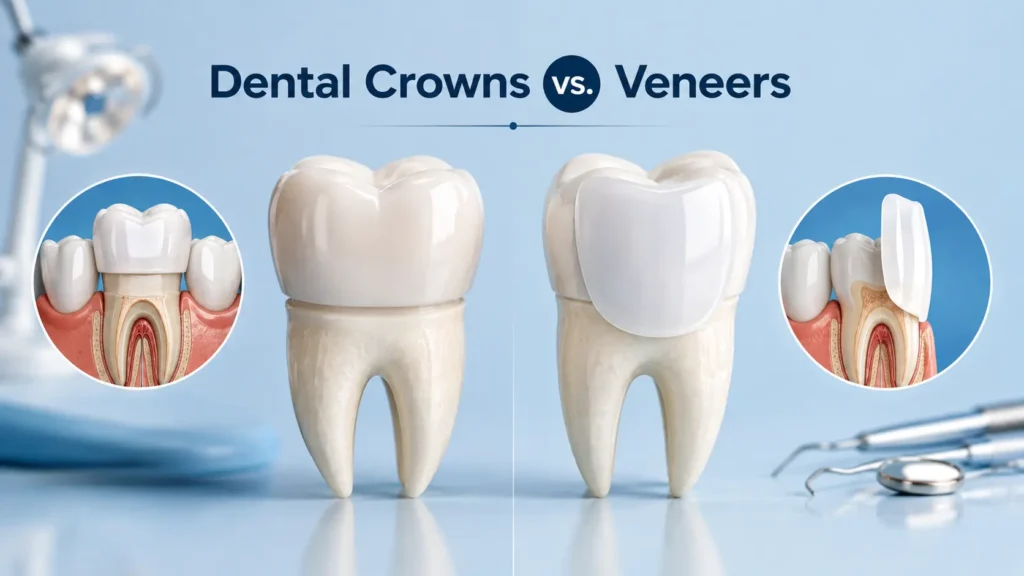
A dental crown covers the entire visible portion of a prepared tooth and is typically used to restore strength after significant damage, decay or a root canal. A dental veneer covers mainly the front surface and is typically used to improve colour, shape or minor irregularities on an otherwise healthy tooth. The right choice depends on your tooth’s condition, remaining structure, bite and cosmetic goals, which is best confirmed through a dental examination.
Dental Crowns vs. Veneers: What Is the Difference?
The core difference between a dental crown and a dental veneer comes down to how much of the tooth is covered and why the treatment is being done. A crown wraps around the entire visible tooth, essentially acting as a new outer shell that protects what remains of the natural tooth underneath. A veneer, by contrast, is a thin layer bonded mainly to the front surface, designed to change how the tooth looks rather than to rebuild it structurally.
Crowns are generally classified as restorative dentistry, meaning their primary role is to repair and protect a tooth that has lost strength through decay, fracture, wear or previous large fillings. Veneers sit more within cosmetic dentistry, generally used to correct discolouration, chips, gaps or shape irregularities in teeth that are otherwise structurally sound.
This does not mean the two treatments never overlap. A well-made crown can also improve the appearance of a tooth, and a veneer can sometimes help mask a minor chip. However, the underlying purpose, and the amount of tooth preparation each requires, generally remain different.
What Is a Dental Crown?
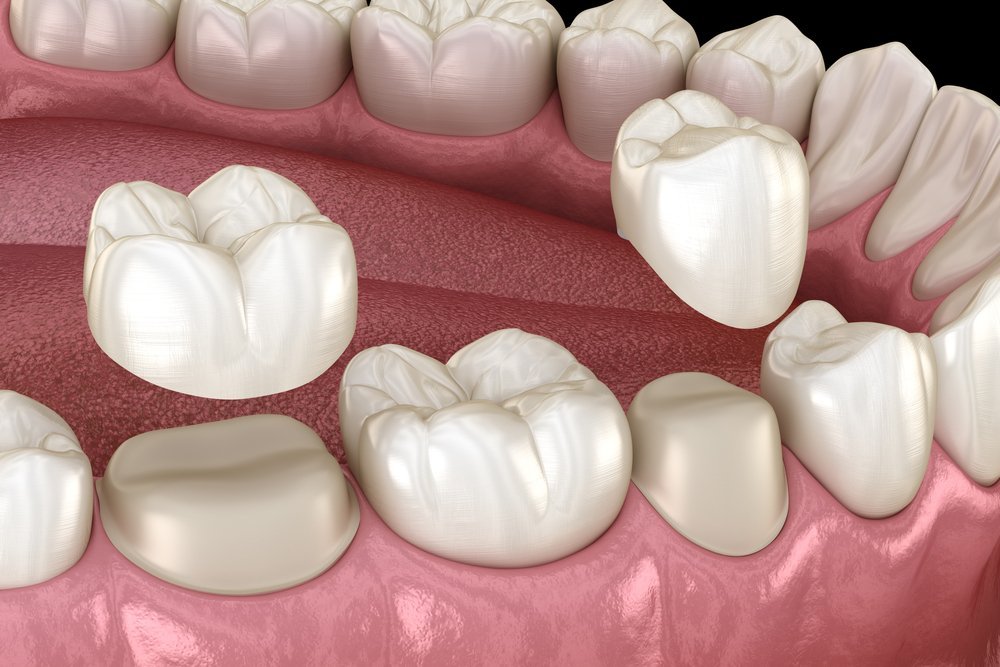
A dental crown is a custom-made cap that covers the entire visible part of a tooth above the gum line. It is fitted over a tooth that has been reduced in size by a dentist so the crown can sit securely and blend with the surrounding bite. Crowns can be made from several materials, including zirconia, ceramic (such as porcelain fused to a strong core), or a combination of materials, with the choice depending on the location of the tooth, bite forces, and aesthetic requirements.
Because a crown encases the whole tooth, it is often the treatment of choice when a tooth has lost a significant amount of its natural structure. This includes teeth with large old fillings that are at risk of fracturing, teeth that have undergone root canal treatment and become more brittle, or teeth with visible cracks that could worsen without added protection.
When Is a Dental Crown Recommended?
A dentist may recommend a crown in situations such as:
- A tooth with extensive decay that cannot be adequately restored with a filling alone
- A tooth that has undergone root canal treatment, since these teeth can become more brittle over time
- A tooth with a significant crack or fracture that affects its strength
- A severely worn tooth, often linked to bruxism or long-term grinding
- A tooth with a very large existing filling that is at risk of breaking further
- Cases where a strong, protective restoration is needed to preserve the tooth long-term
In every case, the final recommendation depends on a clinical examination, and often an X-ray, to assess how much healthy tooth structure remains beneath the surface.
What Is a Dental Veneer?
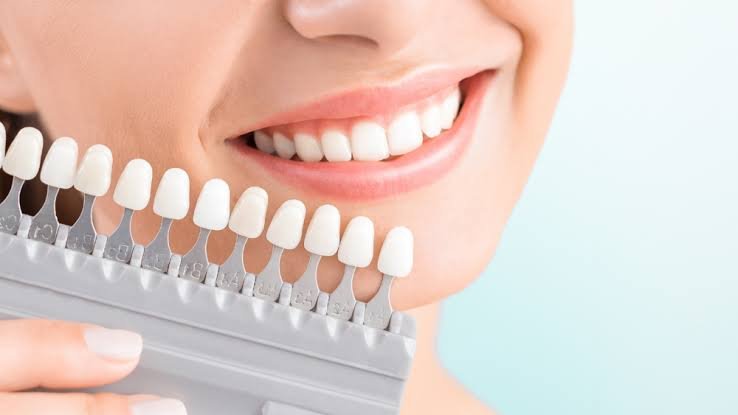
A dental veneer is a thin, custom-shaped shell, most commonly made from porcelain or, in some cases, composite resin, that is bonded to the front surface of a tooth. Veneers are designed to sit over the visible face of the tooth, subtly changing its colour, shape, length or alignment while generally requiring less removal of natural tooth structure than a crown.
Porcelain veneers are typically valued for their ability to mimic the light-reflecting properties of natural enamel, which is one reason they are frequently used in smile makeovers. Composite veneers, built up directly on the tooth using tooth-coloured bonding material, can be a more conservative and often more cost-effective option in certain cases, though they may not offer the same durability as porcelain over time.
When Are Dental Veneers Recommended?
Veneers are often considered suitable for:
- Teeth with staining or discolouration that has not responded well to whitening
- Minor chips or irregular edges on otherwise healthy front teeth
- Small gaps between teeth where orthodontic treatment is not preferred
- Slightly misshapen or unevenly sized teeth
- Patients seeking a cosmetic smile improvement without significant structural issues
Veneers are generally not the first choice for teeth with significant decay, large fillings, or structural weakness, since a thin front shell does not provide the same level of reinforcement as a full-coverage crown.
Dental Crowns vs. Veneers: Key Differences
The table below summarises the main differences to help you understand how the two treatments compare across the factors that matter most when making a decision.
| Factor | Dental Crown | Dental Veneer |
| Coverage | Covers the entire visible portion of the tooth, all the way round | Covers mainly the front (facial) surface of the tooth |
| Main purpose | Restores strength, shape and protection to a weakened or damaged tooth | Improves the colour, shape or alignment of an otherwise structurally sound tooth |
| Tooth preparation | Generally requires more reduction of tooth structure to fit over the whole tooth | Usually requires more conservative, minimal reduction of the front surface |
| Strength / protection | Provides substantial structural reinforcement, often used after root canal treatment or on heavily broken-down teeth | Provides cosmetic improvement but comparatively limited structural reinforcement |
| Cosmetic improvement | Can improve appearance, but primarily a restorative/protective treatment | Primarily a cosmetic treatment for colour, shape and minor alignment |
| Suitable situations | Large fillings, cracks, severe decay, worn or broken teeth, after root canal treatment | Chipped edges, staining, gaps, minor shape irregularities on otherwise healthy teeth |
| Typical longevity | Can often last many years with good care, depending on material and bite forces | Can often last a good number of years with proper care, depending on material and habits |
| Maintenance | Routine brushing, flossing and regular dental check-ups | Routine brushing, flossing, and avoiding habits that place excess stress on the edges |
| Cost considerations | Varies with material, tooth condition, and any additional treatment needed | Varies with material, number of teeth, and the complexity of the smile design |
| Important limitations | Requires more permanent removal of tooth structure; not reversible | Not ideal for teeth needing significant structural repair; also not reversible once prepared |
Are Crowns or Veneers Better for Front Teeth?
There is no single answer, since it depends on the condition of the specific front tooth. For a front tooth that is healthy but discoloured, slightly chipped, or oddly shaped, a veneer is often considered because it preserves more of the natural tooth. For a front tooth with significant decay, a large filling, a deep fracture, or a tooth that has had root canal treatment, a crown may offer better long-term protection.
Many patients ask, “should I get a crown or veneer on my front tooth?” The honest answer is that this decision should follow a clinical assessment rather than a general rule, since front teeth vary widely in how much natural structure remains.
Are Crowns Stronger Than Veneers?
Generally, yes. Because a crown covers the entire tooth, it typically offers more structural reinforcement than a veneer, which mainly covers the front surface. This makes crowns generally more suitable for teeth that face heavier biting forces or that have already lost a substantial amount of natural structure.
Veneers are not designed primarily for strength. Their main function is cosmetic, so while a well-bonded porcelain veneer can be durable, it is not usually intended to replace the reinforcement that a full crown provides to a significantly weakened tooth.
Which Is Better for Chipped or Broken Teeth?
For a minor chip on the edge of an otherwise healthy tooth, a veneer, or sometimes simple dental bonding, may be sufficient to restore appearance. For a more significant break, especially one that affects a larger portion of the tooth or exposes the inner dentine, a crown is often more appropriate because it provides fuller coverage and protection against further breakage.
As a general pattern: smaller cosmetic chips lean toward veneers or bonding, while larger structural breaks lean toward crowns. The exact boundary between these categories can only be judged during an in-person dental examination.
Which Is Better for Discoloured Teeth?
For discolouration that has not improved with professional teeth whitening, veneers are often considered an effective option, since a thin porcelain shell can mask staining while maintaining a natural appearance. Crowns can also address discolouration, particularly when the tooth already needs structural treatment for another reason, since a ceramic crown can be shade-matched to the surrounding teeth.
Where a tooth is otherwise healthy and the only concern is colour, many dentists will first discuss whitening, then veneers, before considering a crown, since crowns involve more removal of tooth structure than is usually necessary for a purely cosmetic colour concern.
Which Lasts Longer: Crowns or Veneers?
Both crowns and veneers can last for many years with good care, and there is no fixed rule that one category always outlasts the other. Longevity depends on the material chosen, the location and function of the tooth, oral hygiene, and habits such as teeth grinding or biting on hard objects. Crowns, particularly zirconia crowns, are often chosen for their durability under heavier bite forces, while well-maintained porcelain veneers can also remain stable for a long period when properly cared for and protected from excess stress.
Regular dental check-ups allow a dentist to monitor how a crown or veneer is holding up over time and address any early signs of wear before they become larger problems.
Do Crowns or Veneers Look More Natural?
Both can look highly natural when properly planned and skilfully made, since modern ceramic materials are designed to mimic the translucency and light reflection of real enamel. Veneers are often perceived as slightly more natural-looking for isolated cosmetic changes because less tooth structure is altered and the shell is thinner, allowing for subtle, layered shading. A well-made crown, however, can also look entirely natural, particularly when colour-matched carefully to neighbouring teeth by an experienced dental laboratory.
Contact us for the best Crown or Veneer services.
How Much Tooth Preparation Is Needed?
Crowns generally require more removal of tooth structure than veneers, since the entire visible tooth needs to be reduced in size to accommodate the cap. Veneers are usually more conservative, often involving preparation of only the front surface, though some tooth reduction is still typically necessary to create space for the material and avoid an overly bulky result.
Neither treatment is reversible once the tooth has been prepared, which is an important consideration when choosing between the two. This is one of the key reasons a thorough dental assessment matters before proceeding with either option.
What Factors Determine Whether You Need a Crown or Veneer?
A dentist typically considers several factors before recommending a crown, a veneer, or an alternative treatment such as dental bonding or a filling. These factors generally include:
- The amount of healthy tooth structure remaining
- Whether there is active decay or an existing large filling
- The presence of cracks or fractures
- The condition of the enamel and underlying dentine
- Gum health around the tooth
- Your bite and how the teeth come together (occlusion)
- Habits such as teeth grinding or clenching (bruxism)
- Whether the concern is primarily cosmetic or primarily structural
- Your overall oral health and expectations for the outcome
Because these factors vary from patient to patient, and often from tooth to tooth within the same mouth, a dental examination, sometimes supported by X-rays, remains the most reliable way to determine the appropriate treatment.
Dental Crowns vs. Veneers in Islamabad
Patients in Islamabad and Rawalpindi researching crowns or veneers are often comparing options before booking a consultation, which is a sensible first step. A few practical considerations can help when choosing where to have this type of treatment carried out locally.
Look for a dental clinic that carries out a proper diagnostic examination, rather than recommending a specific treatment before assessing the tooth in detail. Material selection matters too; ask which type of crown or veneer material is being proposed and why it suits your particular case. A clear treatment plan, realistic expectations about appearance and longevity, and a clinic that explains aftercare and hygiene requirements are all reasonable things to expect.
Follow-up appointments are also part of responsible care, since a dentist will usually want to check how a new crown or veneer is settling, particularly regarding bite comfort and gum health around the restoration. At Lumino Dental Clinic, treatment planning for crowns and veneers begins with this kind of assessment, so patients in Islamabad and Rawalpindi can understand their options before deciding on a direction.
How to Choose the Right Treatment for Your Smile
If you are trying to decide between a crown and a veneer, it can help to start by asking whether your main concern is appearance, strength, or both. A tooth that is chipped, discoloured or slightly irregular but otherwise healthy often points toward a veneer. A tooth that is cracked, heavily filled, or has undergone root canal treatment often points toward a crown.
From there, the most reliable next step is a consultation with a dentist who can examine the tooth directly, review any necessary X-rays, and discuss your goals. Many patients benefit from a combination approach, for example crowns on teeth needing structural protection and veneers on adjacent teeth needing only cosmetic refinement, as part of a broader smile makeover plan.
Frequently Asked Questions
What is the main difference between a crown and a veneer?
The main difference is coverage and purpose. A crown covers the entire visible part of a tooth and is generally used to restore strength after damage or decay. A veneer covers mainly the front surface and is generally used to improve colour, shape or minor alignment on a tooth that is otherwise structurally sound.
Are crowns stronger than veneers?
Generally, yes. Crowns are designed to provide broader structural coverage, which typically makes them more suitable for teeth that are significantly weakened, cracked, or heavily filled. Veneers can look excellent cosmetically, but they are not usually designed to reinforce a tooth that has lost significant structure.
Are veneers better than crowns for front teeth?
It depends on the tooth. For front teeth that are healthy but discoloured, chipped at the edge, or slightly irregular in shape, veneers are often considered because they preserve more natural tooth structure. If the front tooth has extensive decay, a large filling, or a significant fracture, a crown may be the more suitable option.
Can a veneer fix a chipped tooth?
A veneer can often improve the appearance of a minor chip, particularly on the edge or front surface of a tooth. For larger chips or fractures that affect the tooth’s strength or extend below the gum line, a dentist may recommend a crown or another restorative option instead, depending on the extent of the damage.
Can a crown improve the appearance of a tooth?
Yes. While a crown’s primary purpose is usually structural protection, modern ceramic and zirconia crowns can also be shaded and shaped to closely match surrounding teeth, so a crown can improve appearance while restoring strength at the same time.
Which lasts longer, crowns or veneers?
Both can last for many years when properly cared for, and longevity depends heavily on material choice, bite forces, oral hygiene and habits such as grinding. Crowns are often chosen for teeth under heavier functional load, while veneer longevity depends greatly on avoiding excess pressure on the thin front layer.
Are veneers permanent?
Veneers are generally considered a long-term treatment rather than a temporary one, but they are not usually reversible, since a small amount of enamel is typically removed to prepare the tooth. Veneers may eventually need replacement due to wear, staining at the margins, or changes in the surrounding teeth.
Do crowns require more tooth preparation than veneers?
In most cases, yes. Because a crown needs to cover the entire visible tooth, more of the natural tooth structure is usually reduced compared with a veneer, which typically only involves the front surface. The exact amount always depends on the individual tooth’s condition.
Can you get veneers on weak teeth?
This depends on how weak the tooth is. Veneers are generally not recommended for teeth with significant decay, large fillings, or structural weakness, since they do not provide the same level of reinforcement as a crown. A dental examination is needed to assess whether the remaining tooth structure can support a veneer.
How do I know whether I need a crown or veneer?
The only reliable way to know is through a dental examination, which may include a visual assessment, bite evaluation, and X-rays where needed. A dentist will look at the amount of remaining healthy tooth structure, any decay or cracks, your bite, and your cosmetic goals before recommending crowns, veneers, or another option.
How much do dental crowns cost in Islamabad?
Crown costs vary depending on the material used, the number of teeth involved, the complexity of the case, and any laboratory work required. Because every case is different, an accurate cost can only be given after a consultation and treatment plan at a dental clinic such as Lumino Dental Clinic.
How much do veneers cost in Islamabad?
Veneer costs depend on factors such as the material chosen, the number of teeth being treated, and the level of smile design work involved. As with crowns, a precise figure requires an in-person assessment, since no two smile makeover plans are exactly the same.
Can a dentist tell me whether crowns or veneers are better for me?
Yes. A qualified dentist can assess your tooth structure, bite, gum health and cosmetic goals during a consultation and recommend the option, or combination of options, best suited to your individual case. This is the safest way to make a decision rather than choosing based on general information alone.
How should I care for crowns and veneers?
Both generally benefit from regular brushing and flossing, routine dental check-ups, and avoiding habits such as biting hard objects or grinding without protection. Depending on the case, a dentist may recommend a night guard, particularly for patients who clench or grind their teeth during sleep.
Conclusion
Dental crowns and veneers serve different, complementary purposes. Crowns provide fuller coverage and greater structural protection, which generally makes them suitable for teeth that are significantly damaged, decayed, or weakened. Veneers focus primarily on the visible front surface of a tooth and are generally used to improve colour, shape and minor irregularities on teeth that are otherwise structurally healthy.
Neither treatment is universally better than the other. The right choice depends on the condition of your individual tooth or teeth, your bite, your oral health history, and your cosmetic goals. A professional dental examination remains the safest and most accurate way to determine which option, or combination of options, is right for your smile.
If you are in Islamabad or Rawalpindi and weighing up crowns versus veneers, the team at Lumino Dental Clinic can carry out an assessment and walk you through the options that suit your specific tooth condition and goals.