Dental implants are fixed permanently into the jawbone and generally offer better stability, a more natural feel, and stronger chewing ability. Dentures are removable and usually cost less upfront, making them a practical choice for patients who cannot or prefer not to undergo implant surgery. The right option depends on your bone health, gum condition, number of missing teeth, budget, and your dentist’s assessment.
If you have lost one or more teeth, you are probably weighing up two options: dental implants or dentures. Both replace missing teeth, but they work in completely different ways, and the right choice is not the same for everyone.
Some patients want fixed teeth that feel permanent. Others want a solution that does not involve surgery, or that fits a tighter budget. This is exactly why the question “dental implants vs dentures, which is better” comes up so often at dental clinics in Islamabad and Rawalpindi.
This article walks you through how each option works, their real advantages and disadvantages, what affects the cost, and how to think about the decision based on your own dental condition.
What Are Dental Implants?
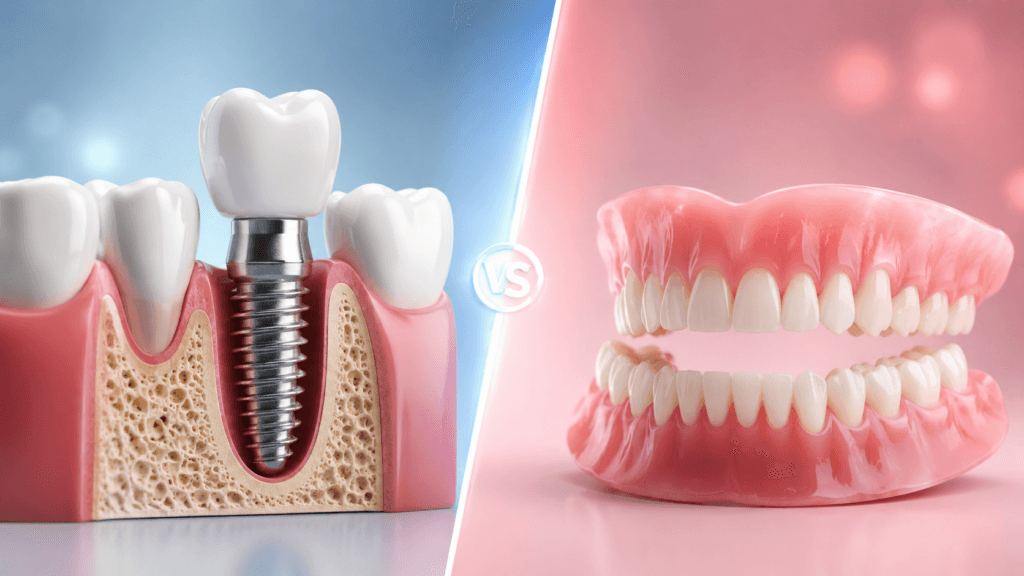
A dental implant is an artificial tooth root, usually made of titanium, that is placed directly into your jawbone. Once it is placed, the bone gradually fuses around it over a period of weeks to months. This process is what makes implants feel so stable, since the implant post essentially becomes part of your jaw.
After the implant post has integrated with the bone, a dental crown is attached on top. The crown is the visible, tooth-shaped part that is designed to match the colour and shape of your natural teeth.
Because the implant is anchored in the jawbone rather than sitting on the gums, it functions much like a real tooth root. This is why implant-supported teeth tend to feel more secure when chewing, speaking, or smiling, and why dental implants are often considered a long-term tooth replacement option.
What Are Dentures?
Dentures are removable artificial teeth that sit on top of your gums. They are one of the oldest and most widely used tooth replacement options, and they remain a practical choice for many patients today.
There are two main types:
- Complete dentures – used when all teeth in the upper or lower jaw are missing.
- Partial dentures – used when only some natural teeth remain, filling the gaps left by missing teeth.
Dentures are held in place by suction, denture adhesive, or, in the case of partial dentures, small clasps that attach to nearby natural teeth. They need to be removed daily for cleaning and are usually soaked overnight in a cleaning solution as part of routine denture maintenance.
For patients who are not suitable candidates for implant surgery, or who want a non-surgical way to restore their smile and chewing ability, dentures can be a genuinely practical option for missing teeth.
Dental Implants vs Dentures: Key Differences
The table below compares dental implants and dentures across the factors that matter most to patients. Keep in mind that individual results and suitability vary from person to person, and your dentist’s assessment is what ultimately determines which option works for you.
| Feature | Dental Implants | Dentures |
| Fixed or removable | Fixed permanently in the jawbone | Removable, taken out for cleaning |
| Stability | Very stable, functions like a natural tooth | Can shift or move, especially while eating or speaking |
| Appearance | Designed to look and feel like a natural tooth | Can look natural but may appear slightly bulkier |
| Chewing | Chewing ability close to natural teeth | Chewing ability is reduced, especially with hard foods |
| Jawbone support | Helps preserve jawbone through natural stimulation | Does not stimulate the jawbone, so bone loss may continue |
| Maintenance | Brush and floss like normal teeth | Requires daily removal, cleaning, and soaking |
| Longevity | Can last many years with good care | Usually need adjustment or replacement every several years |
| Treatment time | Longer process, involves healing time after surgery | Shorter process, can often be fitted more quickly |
| Initial cost | Generally higher upfront investment | Generally lower upfront cost |
| Suitability | Depends on jawbone health and gum condition | Can suit patients not eligible for implants or on a tighter budget |
Dental Implants vs Dentures: Pros and Cons
Advantages of Dental Implants
- Strong stability, similar to natural teeth
- Natural-looking smile that blends with surrounding teeth
- Better chewing function, including harder foods
- Can serve as a long-term tooth replacement option
- Helps preserve the jawbone by keeping it stimulated
- No need to remove them daily, unlike removable dentures
Disadvantages of Dental Implants
- Higher initial cost compared to dentures
- Involves a surgical procedure and healing period
- Longer overall treatment process, from planning to final crown
- Adequate jawbone density and healthy gums are usually required
- Not every patient is an immediate candidate without further evaluation
Advantages of Dentures
- Usually a lower initial cost than implants
- Non-surgical option for replacing teeth
- Can replace multiple missing teeth, or a full arch, at once
- Removable, which some patients find easier to manage
- Can be suitable for patients who are not candidates for implants
Disadvantages of Dentures
- Can move or shift while eating or speaking
- Require daily removal and cleaning
- May need periodic adjustment or eventual replacement
- Can feel less natural than fixed teeth for some patients
- Do not provide the same jawbone stimulation as implants, so bone loss may continue
Dental Implants vs Dentures Cost in Pakistan
One of the most common questions patients ask is about dental implants vs dentures cost in Pakistan. There is no single fixed price for either option, because cost depends on several factors specific to each patient’s case, including:
- Number of teeth being replaced
- Type and quality of the implant used
- Material of the dental crown
- Condition of the jawbone, including whether bone grafting is needed
- Type of denture required, complete or partial
- Diagnostic scans and X-rays needed for planning
- The dentist’s expertise and clinical approach
- Overall complexity of the treatment plan
Generally speaking, dental implants cost in Islamabad tends to be higher upfront than dentures cost in Islamabad, since implants involve a surgical procedure, implant materials, and a custom crown. Dentures typically involve a lower initial cost but may need adjustment or replacement over the years.
Because pricing depends so heavily on individual factors, the most reliable way to understand your costs is a personalised dental examination and treatment plan, rather than comparing generic figures found online.
Which Is Better: Dental Implants or Dentures?
There is no single answer that applies to everyone. Whether dental implants or dentures are better depends on your oral health, budget, and personal priorities.
Dental implants may be better if:
- You want fixed teeth rather than a removable appliance
- You are looking for better stability and chewing function
- You have adequate jawbone density and healthy gums
- You want a long-term tooth replacement option
- You are comfortable undergoing a surgical treatment
- You would prefer not to remove your teeth every day
Dentures may be better if:
- You want a non-surgical treatment option
- Budget is an important factor in your decision
- You need to replace many missing teeth at once
- You are not currently a suitable candidate for implants
- You prefer a removable solution you can take out when needed
If a tooth is damaged rather than already missing, your dentist may first need to decide whether it can be saved or should be removed before implants or dentures even become relevant. Our guide on Root Canal vs Tooth Extraction: Which Is Right for You? explains how that decision is made.
Are Dental Implants Better Than Dentures for Older Adults?
Age alone does not determine whether someone is suitable for dental implants. What matters more is the condition of the gums, the density of the jawbone, general health, and the ability to maintain good oral hygiene.
Many older adults are perfectly good candidates for dental implants, provided their bone and gum health support it. Others may find dentures more practical, particularly if there has been significant bone loss over the years or if managing a surgical procedure is not preferred.
When comparing dental implants vs dentures for older adults, your dentist will typically look at:
- Gum health
- Bone health and density
- General health and any relevant medical history
- Ability to maintain daily oral hygiene
- Number of missing teeth
- Personal expectations and lifestyle
A proper dental consultation is the only reliable way to know which option suits an older patient, rather than assuming age itself rules out implants.
How Long Do Dental Implants Last?
Dental implants can provide a long-term solution for tooth replacement when they are properly planned, placed, and maintained with good oral hygiene. The implant post itself, once fused with the jawbone, is designed to function for many years.
That said, the crown or prosthetic part attached to the implant may need replacement sooner, depending on wear, bite force, and how well it is cared for. Implant longevity is not guaranteed and depends on factors such as oral hygiene, regular dental check-ups, and overall gum health.
How Long Do Dentures Last?
Dentures are not a permanent solution and typically require adjustment, repair, or replacement over time. As the gums and jawbone gradually change shape, especially after tooth loss, the fit of dentures can loosen.
Factors that affect how long dentures last include:
- Everyday wear and tear
- Changes in gum and jawbone shape over time
- How well the dentures fit
- Cleaning habits and denture maintenance
- Daily use and handling
- Overall oral health
Most patients need their dentures reassessed, adjusted, or replaced every several years to maintain comfort and function.
What Should You Choose?
Choose implants if: stability and a long-term, fixed tooth replacement are your priority, and your dentist confirms you are a suitable candidate.
Consider dentures if: you prefer a removable, generally more affordable option, or if implants are not currently suitable for your jawbone or gum condition.
Reading about dental implants vs dentures pros and cons online is a useful starting point, but it cannot replace an actual dental examination. Your gums, jawbone, bite, and medical history all play a role in determining the right option for you.
Why a Dental Consultation Matters
It can be tempting to decide based on articles and reviews alone, but tooth replacement decisions are personal. A dentist needs to physically assess several things before recommending implants, dentures, or another approach, including:
- Which teeth are missing and how many
- Gum health
- Jawbone condition and bone density
- Condition of your existing natural teeth
- Your bite and jaw alignment
- Oral hygiene habits
- Relevant medical history
- X-rays or other dental imaging, where required
This is why a dental consultation in Islamabad, rather than a generic online comparison, is the step that actually determines whether implants or dentures are right for your mouth.
Talk to Lumino Dental & Aesthetics Clinic About Your Options
Not sure whether dental implants or dentures are right for you? The best choice depends on your teeth, gums, jawbone, and personal needs, and that is something an online article cannot fully answer on its own.
Lumino Dental & Aesthetics Clinic, located in F-8 Markaz, Islamabad, offers dental implant treatment and consultations for patients looking to replace missing teeth. During a consultation, your dentist can examine your oral health, discuss whether implants, dentures, or another approach fits your situation, and walk you through a personalised treatment plan.
If you are in Islamabad, Rawalpindi, or nearby areas and are weighing tooth replacement options in Islamabad, you can book a consultation with Lumino Dental & Aesthetics Clinic to discuss your dental condition and receive guidance suited to your own case.
Frequently Asked Questions
Are dental implants better than dentures?
Dental implants generally offer more stability, a more natural feel, and better chewing function than dentures. However, dentures can be a practical, non-surgical, and more affordable option for some patients. Whether implants are “better” depends on your jawbone health, gum condition, budget, and personal preferences, which your dentist can assess.
What is the difference between dental implants and dentures?
Dental implants are fixed into the jawbone through a minor surgical procedure and function like natural teeth. Dentures are removable appliances that sit on the gums and can be taken out for cleaning. Implants tend to feel more stable, while dentures are non-surgical and easier to obtain quickly.
Are dental implants more expensive than dentures?
Yes, dental implants usually involve a higher initial cost than dentures because of the surgical procedure, implant materials, and crown work involved. Dentures are generally more affordable upfront, though they may need periodic adjustment or replacement over the years, which can add to long-term costs.
How long do dental implants last?
Dental implants can provide a long-term tooth replacement option when properly planned, placed, and maintained with good oral hygiene. The implant post itself is designed to last many years, though the crown or prosthetic part sitting on top may need replacement sooner depending on wear.
How long do dentures last?
Dentures are not permanent and typically need adjustment, repair, or replacement over time. As your gums and jawbone change shape, the fit of your dentures can loosen. Most dentures need to be reassessed or replaced every several years, depending on wear and how well they are maintained.
Can everyone get dental implants?
Not everyone is an immediate candidate for dental implants. Adequate jawbone density, healthy gums, and good overall health are usually required. Patients with significant bone loss may still be able to get implants after additional procedures like bone grafting. A dental consultation is the only way to know for sure.
Are dentures comfortable?
Dentures can feel comfortable once you get used to wearing them, though many patients notice an adjustment period at first. Some people experience occasional slipping or irritation, particularly with lower dentures. Regular check-ups and proper fitting by your dentist help keep dentures comfortable and functional.
Can dentures replace all missing teeth?
Yes, complete dentures can replace an entire upper or lower set of teeth, while partial dentures can replace a few missing teeth around your remaining natural teeth. Dentures are often chosen when multiple teeth need replacement and a non-surgical, more affordable route is preferred.
Which is better for older adults, implants or dentures?
There is no single answer based on age alone. Older adults with healthy gums, sufficient jawbone, and good general health can often still get dental implants. Others may find dentures more practical due to bone loss or medical considerations. Your dentist can assess your specific situation.
What is the best option for missing teeth?
The best option for missing teeth depends on your oral health, the number of teeth missing, your jawbone condition, and your budget. Dental implants are often recommended for a fixed, long-term solution, while dentures can be a suitable and more affordable alternative. A dental consultation helps determine the right fit.
Final Thoughts
When it comes to dental implants vs dentures, neither option is automatically the “better” choice for every patient. Implants tend to offer more stability, a more natural feel, and long-term durability, while dentures remain a practical, non-surgical, and generally more affordable route for many people.
The right decision depends on your jawbone, gum health, budget, and how many teeth need replacing. A dental consultation is the most reliable way to move from general information to a treatment plan that actually fits your mouth and your goals.